Autumn wedding guest dress: how to choose the cut, fabric, and length
To choose an autumn guest dress, compare how it fits the wedding and how it allows you to move. Color is part of the decision; the cut, coverage, length, and its relationship with the garment you will wear over it also matter. You may like a dress in a photograph and find it needs adjustments that are best identified before buying.
This guide serves to choose the base of the outfit. Start with the invitation and the type of celebration: there is no mandatory length, fabric, or color for all autumn weddings. If the information is not clear, ask the hosts before discarding or buying an option.
Define what you need before looking at styles
Write down the dress code, time, location, and whether there are coverage requirements during the ceremony. Add a personal preference that helps you filter: for example, being able to wear your regular bra, avoiding a hem that touches the floor, or finding a sleeve that doesn't need constant readjustments.
Autumn does not force you to wear dark colors. You can consider shades that you like and that the celebration permits. Reserve white, ivory, and shades very close to white for an express indication or confirmation from the hosts, especially if the wedding is held on the coast.
Compare the dress in motion, not just from the front
In a wrap neckline, check how it sits when you sit down or lean forward; in a strap model, check the actual fit and underwear support. If the waist has elastic, a drawstring, or a tie, verify that it remains comfortable in different postures. The possibility of adjusting a detail does not replace checking the garment's measurements.
| Element | Practical test | Ask before buying online |
|---|---|---|
| Neckline and bust | Sit, lean forward, and raise your arms | Bust measurement and adjustment system |
| Waist and hips | Walk and sit without tension | Measurements and presence of elastic |
| Sleeve | Move your arms with the jacket on | Sleeve shape and cuff closure |
| Length and slit | Take long strides and walk up a step | Total length and position of the slit |
The length shown on a model does not necessarily match yours. Compare it with a garment that fits you well and with the planned footwear. If you need a reference, use the guide to measure dress length when buying online.
Look at the construction in addition to the fabric name
Composition provides information, but it doesn't answer all questions about drape, thickness, or transparency on its own. Observe if there are openwork areas, layers, slits, or appliqués, and consult what the description does not clarify. Do not assume that a dress is fully lined just because it looks like it in a photo.
If it has embroidery or beading, test that your handbag, jewelry, and jacket closure do not snag when you move. Check the care instructions before deciding if it fits the intended use. For sheer areas, expand the check with the guide on linings and transparency in a dress.
Two dresses to compare different solutions
Granada: long sleeves and wrap neckline
The Granada Dress is long, with a floral print in burgundy tones on an animal print base and gold details. Its description notes a wrap-style V-neckline, puffed sleeves, a tie-belt, and velvet cuffs, in addition to a layered skirt with a side slit.
It is useful as an example to check three points: the placement of the neckline, the space for the sleeve inside a jacket, and the behavior of the slit when walking. The fact that it has long sleeves does not define how warm it is on its own; prepare the outer layer according to the celebration.

Talaya: adjustable straps and flowing skirt
The Talaya Dress is a long navy blue viscose dress with gold embroidery, a wrap neckline, and thin adjustable straps. It incorporates a drawstring at the waist, an elasticated gathered back, and a flowing skirt. It is a different base for those who prefer to handle coverage with an outer piece.
Test the fit of the straps and the length before considering the outfit finished. Compare both models with other guest dresses for weddings and events; the choice depends on your measurements, preferences, and the event's dress code.
The final test is done with the complete outfit
Put on the dress, underwear, shoes, handbag, and jacket. Walk, sit down, and look at the result from the side and back as well. If you need to constantly hold the neckline or outer layer in place, resolve that detail before the wedding. Do not choose an option based on having to move carefully throughout the celebration.
Also, check if you could wear it again for another plan, with a reasonable change of accessories. Reusability is an advantage when it fits your life; there is no point in attributing multiple uses to a garment that is only comfortable for a photograph.
Frequently asked questions
Is a midi or long dress better for an autumn wedding?
Neither is better due to the season. Decide based on the invitation, your preferences, and the event itinerary. In both cases, check the hem with your footwear and the ease of walking and sitting.
Do I have to choose long sleeves?
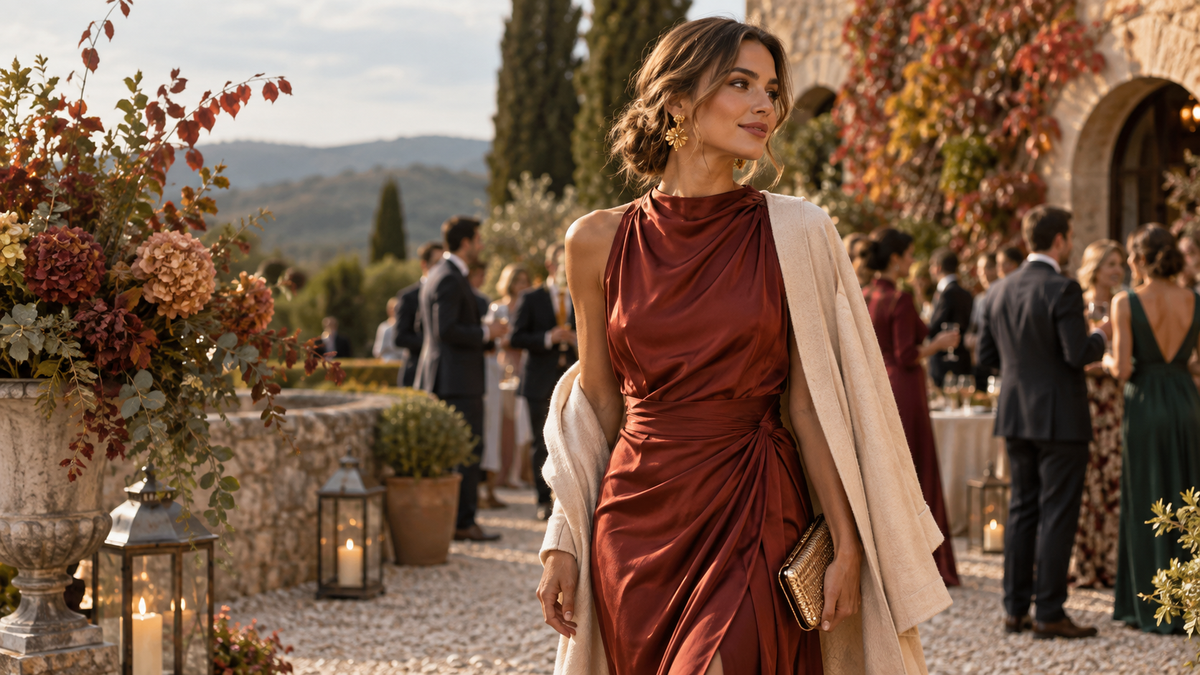
Not necessarily. A sleeveless garment can fit if the dress code allows it and you choose an appropriate outer layer. The sleeve, the dress construction, and the coat should be assessed together.