Loose blouse tucked in or out: how to choose based on the outfit
Wear a loose blouse tucked in when the fabric can be distributed without bulk and you want to show off the waistband; leave it untucked when you like its drape or it has a hem that deserves to be seen. Between both options lies the partial tuck, though it doesn't work for every blouse either. The garment's construction offers better clues than any rule about your height or your body.
The practical question is what happens when you sit down, walk, or raise your arms. A blouse might look impeccable for a few seconds and then come untucked as soon as you reach for something. Another might seem too long in the front and have a beautiful drape when you move. We are going to distinguish those situations to choose a placement you can maintain throughout the day.
Before tucking it in, look at the hem and the front
Spread out the blouse and locate three elements: the shape of the hem, where the pattern ends, and the volume of the fabric. A simple straight edge allows for more experimentation than a border with beading. A curved hem might leave too much fabric in the back and too little in the front. A very loose style might need space inside the waistband that your trousers don't have.
Observe the button placket as well. If the buttons start to pull apart or the collar shifts backward when you tuck in the hem, you are pulling on an area that needs slack. Release fabric until the front returns to its position. Do not try to solve that tension by tightening your belt: it would change the distribution of volume but wouldn't add space.
Blouses with side slits may sit well untucked because the edge adapts differently to the hip. Trapeze-cut blouses retain their shape when left loose. Tucking them in is an aesthetic possibility, although it sometimes eliminates exactly the shape for which you chose them.
Tucked in: useful when the waist has space
This option shows the waistband and provides a better view of darts, pockets, or pleats. Start by tucking the hem in evenly, without pulling it down toward the floor. Then, release a small amount of fabric over the top so you can breathe and move naturally. The amount required depends on the length and the cut, not on a universal measurement.
Turn to the mirror. It is common to tuck in only the front and leave excess fabric accumulated in the back. Distribute the volume with your hand and observe if the trousers maintain their drape. If you notice a continuous bulge at the hip, perhaps the waistband is too tight for that blouse or the fabric is too voluminous.
With a skirt that has a side closure, check that the blouse does not get caught in the zipper. With pleated trousers, see if the pleats open up due to the added fabric. If tucking in the blouse changes the fit of the bottom half too much, try another placement before concluding that you need a different size.
Untucked: let the pattern do its work
A loose blouse doesn't need to reach a specific point to be valid. It can end near the waistband, at the hip, or below. The useful thing is to observe if it falls freely or gets caught on pockets, knots, and seams. If the edge rises due to a detail on the trousers, a simpler base can solve it without touching the blouse.
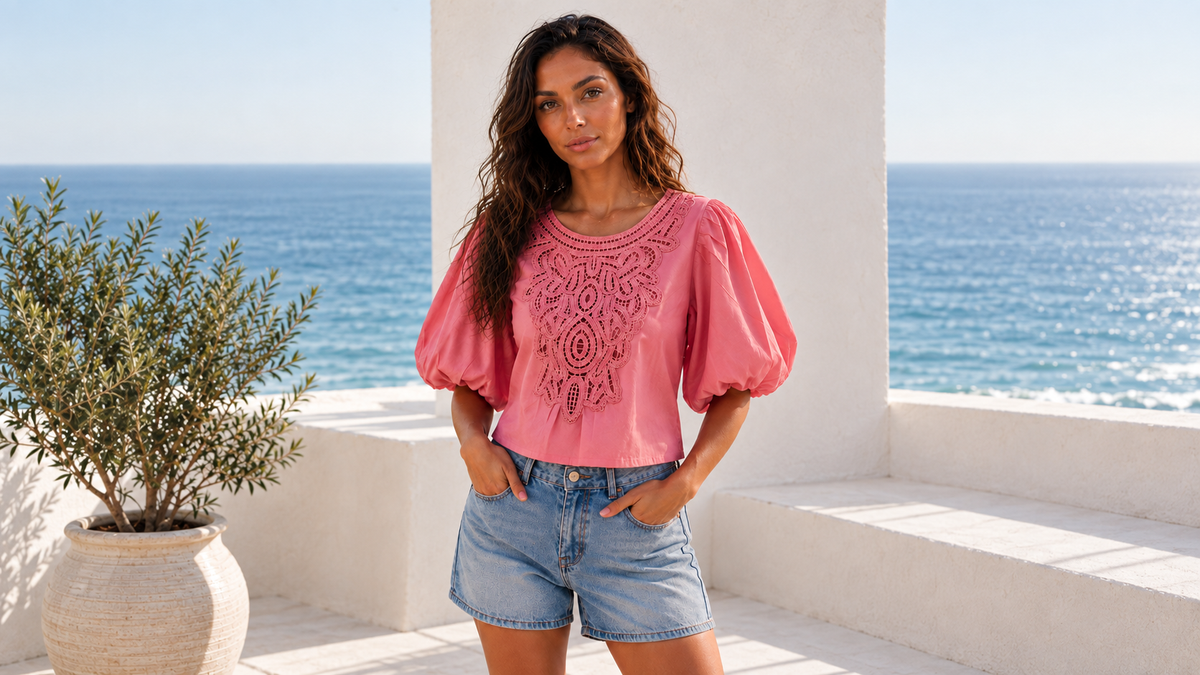
The Bougainvillea Guipure Blouse has an openwork central panel, short balloon sleeves, and a length described as falling at the hip. Its photograph allows you to see the complete pattern when the hem is left loose. It is an example of a garment where tucking in the front too much could hide part of the motif that draws the attention.

If you add a shorter jacket, a strip of the blouse will be visible underneath. Decide if you want that overlap. You can keep it to define layers or choose a jacket of a different length. You don't always have to hide the hem: it is enough that you like the relationship between both garments, whether open or closed.
Partial tuck: less fabric inside, more decisions
To test it, tuck in a small section of the front without tightening the neckline. The rest should fall without getting caught on the sides. Look to see if a diagonal appears that you like or if the hem looks like it got caught by accident. A central lace detail might lose its shape if you tuck it in right in the middle.
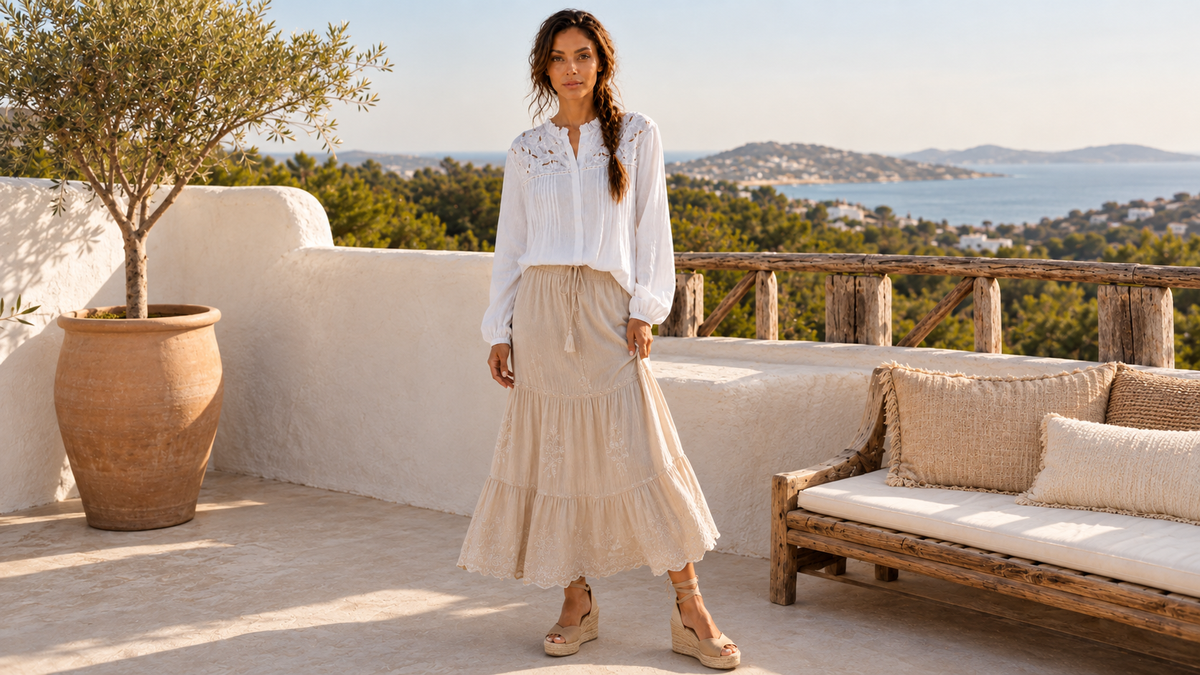
With the Azahar Blouse, you can compare the slightly tucked-in front with the version left completely loose. Its guipure yoke sits in the upper area, while the pintucks run down the front. Check that the lines continue to fall naturally and that the button placket does not tilt due to a pull to one side.
A side tuck can leave the center free, but it introduces asymmetry. If the skirt already has a slit or a drape on that side, evaluate whether you want to concentrate both details there. Change only the position of the blouse and keep the rest the same to distinguish what effect it really produces.
What changes depending on the trousers or skirt
| Bottom | First option to try | What to observe |
|---|---|---|
| Smooth waistband with space | Blouse tucked in | Fabric distribution at the back and hip |
| Waist with tie or details | Blouse loose or partially tucked | Ensure the elements don't get in each other's way |
| Skirt with a lot of gathering | Hem free or small tuck | Where both volumes are concentrated |
| Low-rise trousers | Blouse untucked | Coverage when sitting and raising arms |
These are starting points, not mandatory results. A very thin blouse can easily fit into a gathered skirt; a stiffer one might be uncomfortable in seemingly roomy trousers. The test must be done with the actual garments. To choose the complete outfit, you have ideas in embroidered blouse with dress trousers.
The base layer counts too
If you use a top underneath, place that layer first exactly as you want to wear it and then add the blouse. Tucking both in together can create more creases or cause one to drag the other down. Check if the top is visible at the hem when you sit down and if that strip is part of the look you want.
In openwork areas, changing the position can alter which part of the base layer is visible. A tucked-in blouse rises slightly when you move and can reveal a different neckline. The guide on base layers for openwork blouses expands on this choice of coverage, color, and length.
The rehearsal that decides better than a photo
Do three quick tests: sit down as you would at a table, reach for an object at shoulder height, and put on your jacket. Then let your arms relax. If you have to rebuild the entire tuck, try a smaller section or wear the blouse loose. A useful placement returns to its place with minimal adjustment.
When the trousers have a belt, also check that the buckle does not press against buttons, beads, or cords. The belt can be part of the look, but it shouldn't be the mechanism needed to immobilize a blouse that is pulling everywhere. Changing the placement is usually simpler than adding another piece.
Frequently asked questions
Can I knot a loose blouse?
Only if its construction and the fabric allow it without straining buttons or embellishments. A knot changes the length and concentrates tension. It is not the first option for guipure, beading, or embroidery near the hem.
Does tucking it in always look dressier?
No. A loose blouse with a well-maintained drape can fit perfectly into a dressy outfit. The trousers, footwear, condition of the garment, and the context in which you will use it also matter.
How do I know if the tuck has too much fabric?
If it opens up darts, distorts pockets, tightens the waist, or forms an uncomfortable bulge when sitting, it is best to reduce it. That sign describes the relationship between the garments and does not force you to change your style.