Boho style for work: outfits according to office dress code
To bring boho style to the workplace, start with your office's rules and the day's tasks. Then, incorporate the detail that defines you: an open-knit blouse, an embroidered jacket, or a specific color combination. There is no single boho uniform that works for every profession, but there is a way to adapt your clothes without losing comfort or coherence.
The point isn't to turn all your clothing into formal wear. It's about checking whether each piece allows you to work, move, and participate in the expected situations. A day of video calls, an external meeting, and a day of administrative tasks might require different choices, even if they happen at the same company and within the same week.
How to interpret your workplace dress code
If there is a dress code, use it as your main reference. When the instructions are ambiguous, ask about specific points that affect you: footwear, coverage, wearing jeans, or client-facing requirements. Observing the team helps understand the context, but it doesn't replace a rule you haven't been informed about.
Separate image concerns from the requirements of the activity. A position may require a uniform, specific footwear, or the absence of elements that interfere with tasks. In that case, aesthetic advice is subordinate to those conditions. Do not try to solve a functional obligation simply by changing the color of a garment.
It is also worth looking at your agenda. Presenting a project, attending a visit, and working at your desk for hours don't always demand the same outfit. You can prepare two versions of a familiar base and choose the appropriate one in the morning, rather than maintaining a completely different wardrobe for each scenario.
Formal office: focus the character on a single piece
When you need a sober image, start with a base you know fits: dress trousers and closed-toe shoes, for example. Try a blouse with a discreet detail under a jacket that complies with the code. The decision must consider the overall result as well as what remains when you remove that layer.
You might like an open-knit piece and still need an inner garment to provide the coverage you want. Check the contrast between the two and observe the result in office lighting. The guide on what to wear under an open-knit blouse explains how to coordinate necklines and lengths without leaving your choice to chance.
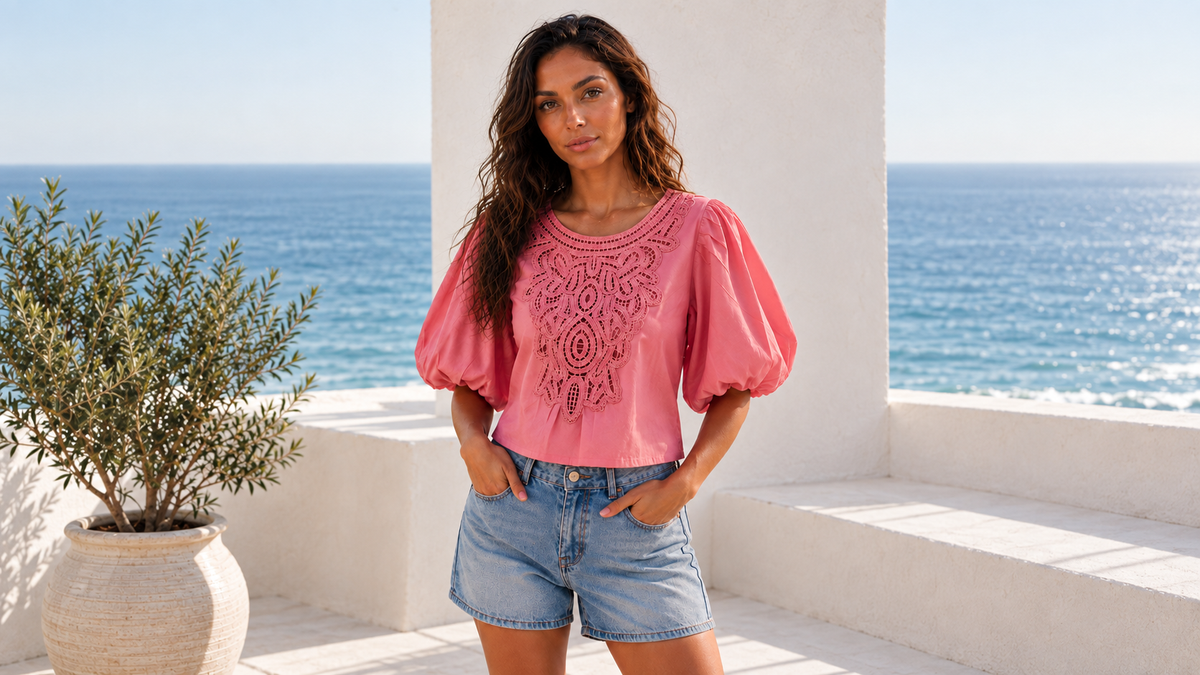
The Azahar Blouse is an option you can consider according to these conditions. Its description mentions a guipure yoke, a mandarin collar, and balloon sleeves. Try it with navy blue trousers and a suitable inner base; then decide if its volume and detail fit your specific environment.

If the jacket makes the sleeves tight or the yoke draws more attention than you want, swap the top for a simpler one. You don't need to force every garment to fulfill all functions. You can save the embroidery for a scarf, a handbag, or a day with different conditions.
Flexible office: play with the contrast between garments
In an environment that allows for smart casual clothing, you can combine an embroidered jacket with a plain t-shirt and straight-leg trousers. Contrast helps keep the outfit easy to repeat: one piece provides the design, and the others allow you to change colors or silhouettes without rethinking every combination each morning.
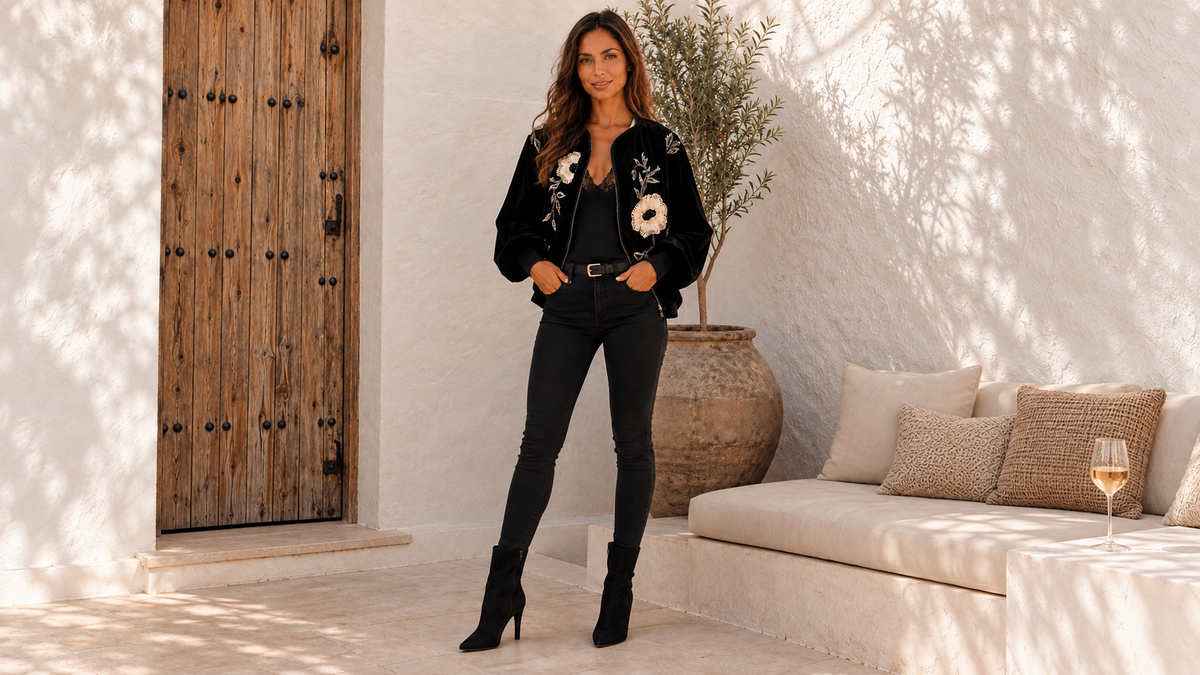
The Lotus Flower Jacket offers a possibility for this formula. It has a bomber cut and zip closure, with floral details on a black base. As an office proposal, try it with an ecru t-shirt and black trousers; add footwear that suits your day and the job's regulations.
Check how it looks when you work with your arms resting on a desk. The embroidery, cuffs, or any appliqués might coincide with the edge of the table. Go through the motions of typing, picking up documents, and reaching for the mouse. A jacket that feels comfortable standing up might need different positioning or not be your best option for prolonged tasks.
If jeans are allowed, decide on the cut based on the fit and the planned activities. A straight leg can work with a loose top; a wider leg can too, if you like that proportion. The practical issue is that the hem shouldn't drag and the waist should be comfortable when sitting, not that there is only one correct pattern.
Active jobs: place details where they won't interfere
If you spend your day moving around, assisting people, or going in and out of spaces, check fasteners and loose elements. Tassels, cords, fringe, and wide sleeves may require attention depending on the activity. Evaluate each actual task before deciding which garment to wear; it's not enough for the outfit to look good in the mirror.
One way to keep your style is to place the visual interest in an area that isn't constantly in contact with your tools or furniture. It could be a print instead of relief, a specific color palette, or a piece you only wear during compatible moments. What is appropriate depends on the conditions of your position.
How you carry your essentials also matters. Put on your work bag with everything inside and check if the strap puts pressure on or rubs against embellishments. If you need ID, check where it rests on the blouse. Resolving these interactions prevents you from choosing a combination that works aesthetically but hinders actions you repeat throughout the day.
Video calls: check the actual framing
On a day with screen meetings, the upper part takes on a different level of prominence. Open a preview with the camera and lighting you will use. Check if the embroidery is recognizable, if the background competes with it, and if the neckline sits as expected when you adopt your usual working posture.
You don't need to ban prints or colors as a rule. Compare two options on your own equipment: a blouse with detail and a plain base with a jacket. The camera might show differences compared to the mirror. If you want to reduce visual noise, change your earrings or background first before automatically discarding a garment you like.
Pay attention to headphones and the microphone. Check that they don't hit necklaces, zippers, or earrings when you turn your head. If you have to stand up during the meeting, the entire ensemble should respond to the same context; preparing only what is initially in the shot can complicate everyday situations.
A small rotation for the week
Choose two bottoms you use frequently and two tops that are compatible with both. Add a jacket that works with at least one plain base. Before considering the selection complete, try out the combinations: colors matching doesn't guarantee that the collars, hems, and sleeves will also work well together.
For example, you can alternate black trousers and navy blue ones with a plain t-shirt and a light-colored blouse. The embroidered jacket goes over the t-shirt when the context allows. The blouse can be worn alone or under another layer whose looseness you have tested. You don't need to repeat exactly the same outfit to make the most of those garments.
If you prefer to work from a specific base, check the proposals for an embroidered blouse with dress trousers. Here, the rotation aims for something else: that you have alternatives for different workdays and can choose quickly according to your schedule and the conditions of your environment.
Take a photo of the combinations that work for you and note the corresponding footwear. Include a version for the commute when it's chilly and another without the outer layer. It's a reference for your own closet, useful so you don't discover on a Monday morning that two familiar garments have never been tried on together.
Three decisions that should be resolved before the first wear
Can I wear a garment with beading to work?
It depends on the code and the tasks. Look at how much it stands out, where it is located, and what surfaces it will come into contact with. A garment might be appropriate in one office and not practical in another position. If there is an express restriction, respect it when preparing the outfit.
What do I do if I wear a coat in the morning and later don't need it?
Check that the inner version has the coverage and look you are after. Do not use the outer layer to hide a fit that you aren't convinced about. Also, decide where to leave it based on available space, especially if you are wearing other bulky items.
Can I repeat a striking jacket several times?
Yes. Change the base when you feel like it or repeat a combination that works. You don't need to buy another garment just to avoid repeating the previous one. What is useful is maintaining a rotation that is compatible with the care needs of each piece and your way of working.