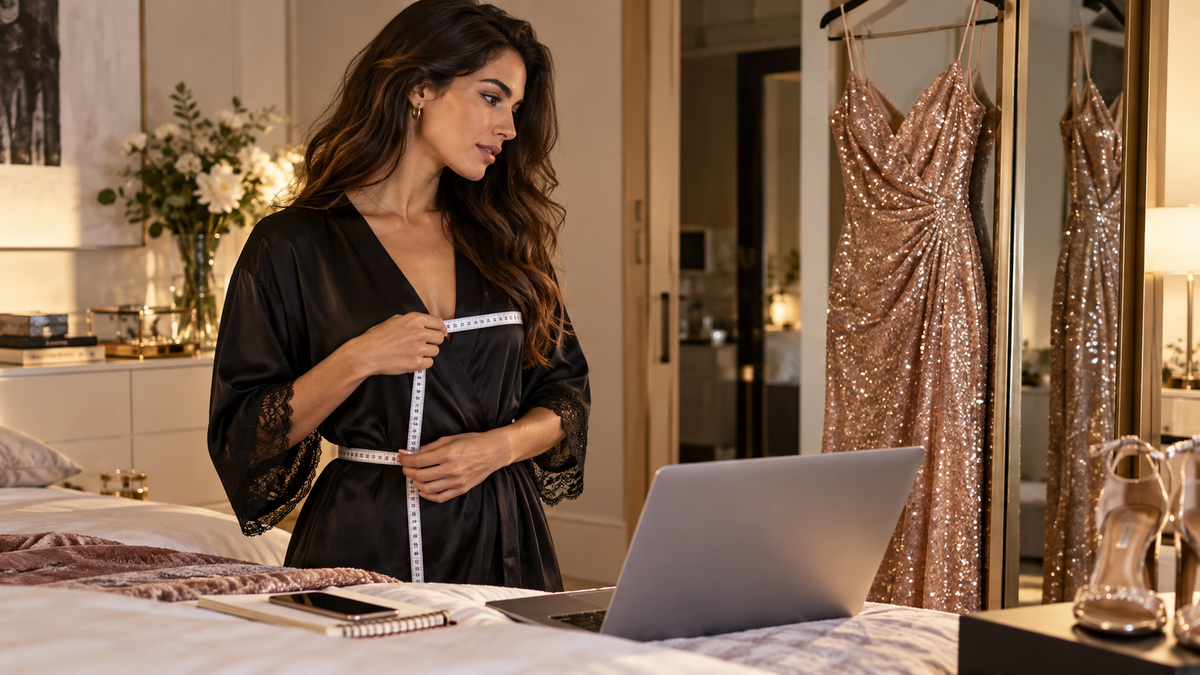
Buying a party dress online: measurements and fit
To buy a party dress online, start with one question: which part of the pattern needs to fit well for the dress to be comfortable? It could be the bust in a fitted bodice, the hips in a straight skirt, or the waist position in a wrap dress. Your usual size is a starting point; measurements and construction help you decide.
Prepare a flexible measuring tape and a dress that fits you well and has a similar cut to the one you are looking for. Consult the guide for the chosen model: body measurements and garment measurements are not interchangeable.
1. Find out what the chart is measuring
A chart may show body measurements or garment dimensions. It may also present the width of the dress laid flat, which is not the same as the full circumference. Before comparing figures, check the method and units. If they are not specified, ask.
Do not apply a fixed amount of extra centimeters to all dresses. The necessary margin changes with the pattern, elasticity, and the fit you desire. A garment designed to be loose-fitting is compared differently than a straight skirt with no stretch.
2. Take measurements without changing your posture
- Bust: wrap the tape horizontally around the fullest part without pulling tight, while wearing the intended undergarments.
- Waist: locate your natural waist and measure without holding your breath. Check where the seam falls on the dress you are looking at.
- Hips: measure the widest part, keeping the tape parallel to the floor.
- Length: use the starting point indicated by the store; do not compare a length from the shoulder with one taken from the waist.
Note the date and repeat any measurements you are unsure about. For the length and hem position, you can follow the guide on how to measure a dress before buying online.
3. Find the area that limits the fit
| Cut type | Check first | Also check |
|---|---|---|
| Fitted bodice and full skirt | Bust and waist | Waist height and sleeve room |
| Straight dress | Bust and hips | Ease for sitting and walking |
| Wrap neckline | Bust circumference and overlap | Whether the overlap is adjustable or sewn |
| Elastic waist | Useful range of the elastic | Bust, armscye, and lining, which may restrict movement sooner |
Two examples for reading the pattern
The Cairo Dress has an elastic waist, kimono sleeves, and a full skirt. Before choosing it, ask for the bust measurement, waist range, and length if those figures are not in the available information. An elastic waist does not confirm that the rest of the dress also stretches.

The Granada Dress combines a wrap neckline, a tie belt, long sleeves, and a side slit. Here it is important to check the neckline coverage, the waist position, and the height of the slit relative to your body. The tie allows you to define the fit, but it does not replace the dress measurements.

4. Do a movement test when you receive it
Try it on with the intended undergarments and footwear, respecting the store's trial and return conditions. Sit, walk, raise your arms, and check the neckline when leaning over slightly. See if the lining pulls before the outer fabric or if a seam is displaced. A photograph while standing does not show all of that.
If you are looking for a one-size-fits-all model, also check which measurements to check on a one-size dress. In the guest dress collection, compare the cut of each design before deciding.
Frequently asked questions
What should I do if one measurement matches and another does not?
Check the fit of the area that does not match and the actual margin of the pattern. Do not automatically choose a larger size: it may change the position of the shoulders, waist, or neckline.
Does the composition tell me how much it stretches?
It is not enough to know the fit. Ask for information about the elasticity of the finished garment and the lining, if it has one, along with the model's measurements.