

The Ibizan color palette: how to combine white, ecru, and terracotta without fail
The Mediterranean style color system, truly explained · By Martina
IN SUMMARY
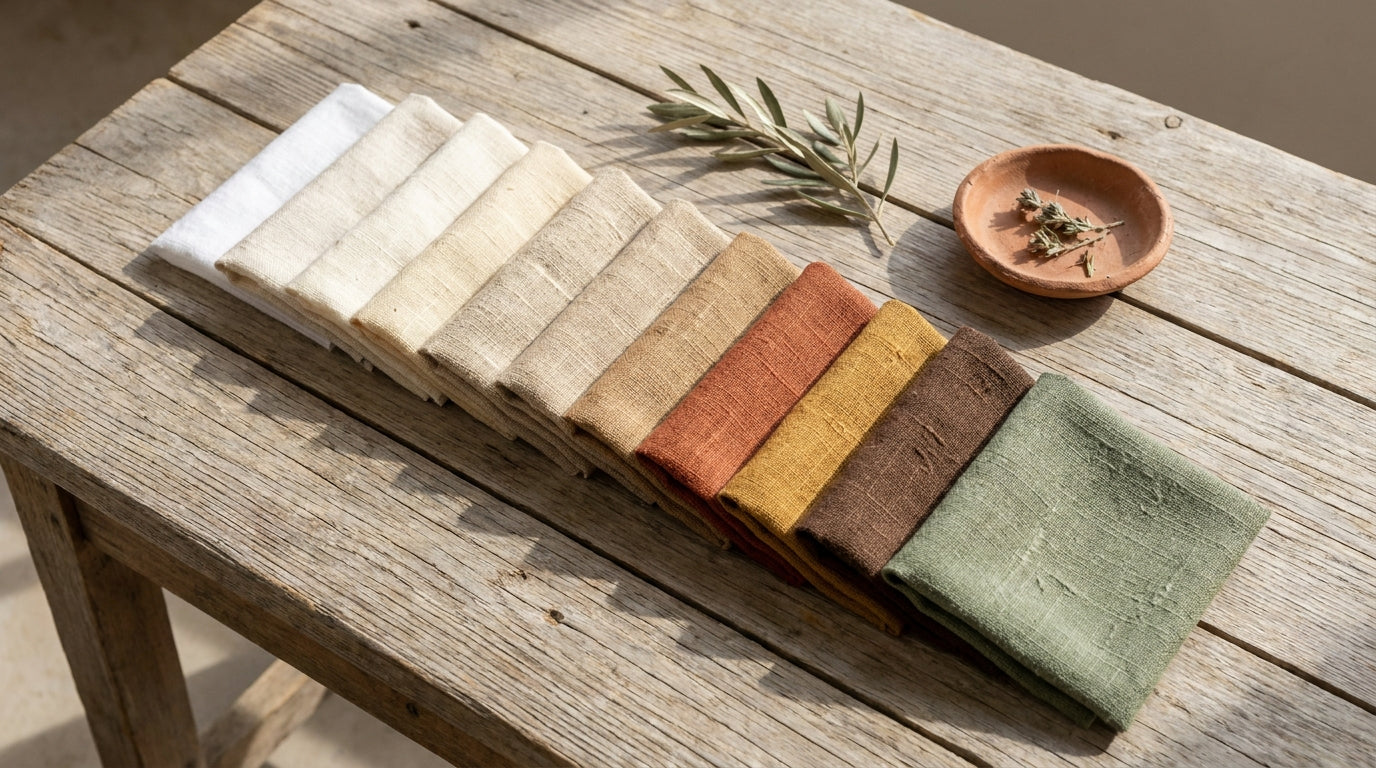
• The Ibizan palette is organized into three families: whites (white, off-white, bone, ivory, vanilla), light earth tones (sand, beige, soft camel), and deep earth tones (terracotta, ocher, muted tile), plus a vegetal accent (sage, diluted olive green).
• The golden rule: always combine within the same "temperature." Warm whites (off-white, ivory) with warm earth tones (terracotta, sand); cool whites with grays and sage. Do not mix pure warm with pure cool.
• A well-constructed Ibizan look uses 2-3 shades from the palette, never more. Elegance lies in tonal harmony, not variety.
• Saturated colors (fuchsia, cobalt, emerald) are outside the code. If you want color, it goes into a single small accent (lips, a detail), never as a protagonist.
A client once told me something that perfectly defines the color problem in the Ibizan style: "I buy pieces that I love separately, and when I put them together in the closet, they don't match." I asked for photos of the closet. The problem was obvious: she had a bluish optical white next to a yellowish off-white next to a grayish beige. Three "neutrals" that fought each other because they were of different temperatures.
And therein lies the most common misunderstanding about the Ibizan palette: people believe that "since everything is white and beige, everything matches." False. Neutrals have temperature (warm or cool), and mixing opposite temperatures is what makes a wardrobe of natural tones look uncoordinated instead of harmonic.
This guide is the complete Ibizan style color system. Not "inspiration," a system: the families of shades, how to combine them, the temperature rule, how many colors to use, and how to choose your own according to your skin. When you understand it, your entire wardrobe will start matching on its own.
The three families of the Ibizan palette
The Ibizan style palette is not "white and not much else." It is a system of natural tones organized into three families, plus a vegetal accent. Knowing the families is the first step to combining well.

Family 1: Whites
The backbone of the code. It is not just one white, but several: pure white (the coldest and cleanest), off-white (white with yellowish warmth, the most common in authentic linen), bone (white with a grayish-pink hint), ivory (creamy warm white), vanilla (white with soft yellow notes). Each has a different temperature, and that matters when combining.
Family 2: Light earth tones
The bridge between whites and deep earth tones. Includes: sand (light warm beige), beige (medium earth neutral), soft camel (beige with a golden hint), greige (gray-beige, the coldest of this family). These are the tones that add depth without breaking the softness of the palette.
Family 3: Deep earth tones
The character color of the code, always in a muted version (never saturated). Includes: soft terracotta (the Mediterranean red-earth), ocher (earth-yellow), muted tile (desaturated earth-orange), tobacco (warm brown). These are the tones that provide a "warm accent" without leaving the code.
The vegetal accent
Outside the three earth families, there is a single "non-neutral" color accepted in the code: green in its muted versions. Sage (soft grayish green), diluted olive green, eucalyptus. It represents Mediterranean vegetation (olive trees, rosemary, sea fennel) and functions as a natural accent. It is the only "color" that the Adlib code allows as a prominent feature.
The golden rule: color temperature
If you only take one idea from this article, let it be this: neutrals have temperature, and the key to combining them is respecting that temperature. This is what separates a harmonic Ibizan wardrobe from one that "doesn't match even though everything is beige."
What is a color's temperature
Every color, even neutrals, has a warm bias (toward yellow-red) or a cool bias (toward blue-gray). Off-white is a WARM white (tends toward yellow). Optical white is COOL (tends toward blue). Sand is WARM. Greige is COOL. Terracotta is WARM. Sage is COOL.
The practical rule
Combine warm with warm and cool with cool. An off-white (warm) dress asks for accessories in terracotta, sand, camel, antique gold (all warm). A bone or cool white dress asks for grays, sage, silver, greige (all cool). When you mix a warm off-white with a cool optical white, the eye perceives that "something doesn't fit," even if it can't identify what. That is the clash of temperatures.
The exception and how to use it
The rule has an expert exception: you can mix temperatures if you introduce a third "bridge" tone that unites them. For example, warm off-white + cool sage clash, but if you add a sand (medium warm) between the two, the ensemble becomes harmonic. This is advanced level: until you master it, stick to the simple rule of warm with warm.
Combinations that always work
Here are the safest chromatic combinations of the Ibizan code, all verified. If in doubt, choose any of these and you won't fail.

Monochromatic combinations (one single tone in several values):
-
1. All off-white: off-white dress + off-white/beige accessories + natural leather footwear. The most elegant and secure.
-
2. All off-white variation: different warm whites together (off-white + ivory + vanilla). Sophisticated and luminous.
-
3. All sand: sand dress + camel accessories + cognac footwear. Warm and enveloping.
Combinations of two families:
-
4. Off-white + terracotta: the quintessential Mediterranean combination. Off-white dress + terracotta accessory or detail. It always works.
-
5. Off-white + sand: soft, sophisticated, very "stealth luxury." Off-white dress + bag and sandals in sand/camel.
-
6. White + sage: fresh and natural. White dress + sage accessories or detail. The muted green gives a botanical touch.
-
7. Sand + tobacco: autumnal within summer, warm and deep. For the end of the season.
Combinations of three tones (advanced level):
-
8. Off-white + sand + terracotta: complete warm gradient. Off-white dress, sand bag, terracotta detail. This is the "three earths" formula that never fails.
-
9. White + sage + natural leather: fresh with a natural base. White dress, sage accessory, leather footwear.
Combinations that DO NOT work
As important as knowing what to combine is knowing what to avoid. These are the most common chromatic errors of poorly executed Ibizan style.

-
1. Cool optical white + warm off-white together. The classic temperature clash. One makes the other look "dirty." Choose a temperature and stick with it.
-
2. Saturated color as a protagonist. A fuchsia, cobalt, or emerald dress is not Ibizan code, no matter how much linen it is made of. Saturated colors break the entire palette.
-
3. Black as the base of a daytime look. Black exists in the code but is minor and almost always for nighttime or accessories. An all-black daytime Ibizan look contradicts the code.
-
4. Too many tones at once. Off-white + sage + terracotta + tobacco + sand all together is chromatic noise. Maximum 3 tones per look.
-
5. Striking multicolor patterns. The code admits patterns, but they must be discreet and within the palette (tone-on-tone embroidery, fine stripes in earth tones). Tropical or ethnic multicolor prints are out.
-
6. Shiny metallics. Gold and silver should be in an aged/matte version, never mirror-finished. A bright, saturated gold breaks the softness of the palette.
How to choose YOUR tones according to your skin
Not all whites or all earth tones look good on everyone. Your skin undertone determines which part of the palette illuminates you and which part dulls you. Here is a quick guide.

If you have a warm undertone (skin tans easily, veins look greenish):
You look good in warm whites (off-white, ivory, vanilla) and warm earth tones (terracotta, sand, camel, ocher). Cool optical white might dull you. Your best star color: terracotta, which enhances golden skin like no other.
If you have a cool undertone (skin reddens in the sun, veins look bluish):
You look good in cool whites (pure white, bone) and cool neutrals (greige, sage, light gray). Very warm terracottas might make you look harsh. Your best star color: sage or optical white, which provide luminosity without overheating.
If you have a neutral undertone (a mix of both, veins look between green and blue):
You're in luck: almost the entire palette works for you. You can play with warms and cools. Your only precaution is not to mix opposite temperatures in the same look. Choose one direction per look and explore the entire palette throughout your wardrobe.
The trick to identify your undertone:
Look at the veins in your wrist in natural light. Greenish = warm undertone. Bluish = cool undertone. A mix = neutral. Another test: do gold (warm) or silver (cool) look better on your skin? The metal that illuminates you indicates your temperature.
How to build a chromatically coherent wardrobe
The ultimate reason for understanding the palette is practical: building a wardrobe where everything matches everything else. This multiplies possible looks with fewer pieces. This is the strategy.

-
1. Choose your "base" according to your undertone. If you are warm, your base is off-white. If you are cool, your base is white/bone. This will be the wardrobe's backbone.
-
2. Buy 60% of pieces in the base and compatible whites. Dresses, tunics, large pieces in off-white/white. These are the ones worn most often and match everything.
-
3. Add 30% in light earth tones (sand, beige, camel). They provide effortless depth and match the base without thinking.
-
4. Reserve 10% for accents (terracotta, sage, tobacco). One piece or accessory in each accent. These are the ones that give personality to the look without breaking coherence.
With this proportion (60% base + 30% light earth + 10% accent), practically any combination in your closet will work, because everything is built on the same temperature and within the same families. It is the magic of a chromatically coherent wardrobe: you stop having "loose pieces that don't match" and start having a system.
If you want to start building your Ibizan wardrobe from the base, our white and off-white dress collection is the perfect starting point (the chromatic backbone that matches everything). And for the earth and terracotta accents that give personality, the shades in the Ibizan dress collection cover the entire warm range of the palette.
Frequently asked questions about the Ibizan color palette
What colors define the Ibizan style?
The Ibizan style is organized into three families of natural tones: whites (white, off-white, bone, ivory, vanilla), light earth tones (sand, beige, camel), and deep earth tones (terracotta, ocher, tobacco), plus a vegetal accent in muted green (sage, diluted olive). Saturated colors are left out of the code.
How do I combine white and off-white without them clashing?
White and off-white pair well if they both have a warm temperature. The problem arises when mixing a cold (bluish) optic white with a warm (yellowish) off-white: the eye perceives that they do not match. The solution is to combine off-white with ivory or vanilla (warm whites) instead of pure cold white.
Can I wear color in an Ibizan-style look?
Yes, but with rules. Muted green (sage, olive) is the only color accepted as a focal point. Other colors only as a very small accent (coral lips, an embroidered detail). Saturated colors (fuchsia, cobalt, emerald) as a main focus break the entire code. The Ibizan palette consists of neutrals and earth tones, not color.
What is skin undertone and why does it matter for choosing color?
The undertone is the shade underlying your skin color: warm (golden), cool (pinkish), or neutral. It determines which shades of the palette brighten you up. Warm skin tones glow with off-white and terracotta; cool tones with pure white and sage. A trick to identify it: greenish veins on your wrist = warm, bluish = cool.
How many colors should I use in the same look?
Between 2 and 3 shades from the palette per look, never more. Ibizan elegance lies in tonal harmony, not variety. A monochromatic look (several values of the same shade) or one with two families (white + terracotta, off-white + sand) is always more sophisticated than one with many colors.
Is black part of the Ibizan palette?
Black exists in the code but is in the minority. It works in accessories and evening pieces (a black linen dress for a dinner), but not as the base of a daytime look. The daytime Ibizan code is built on whites and earth tones; black is reserved for specific moments and almost always at night.
How do I make my whole wardrobe go together?
Build your wardrobe with a 60-30-10 proportion: 60% as your base (off-white if you are warm, white if you are cool), 30% in light earth tones (sand, beige, camel), and 10% in accents (terracotta, sage). Everything within the same temperature. That way, practically any combination works because everything shares the same family and color temperature.
About the author
Martina is the founder of Martina Ibiza, a contemporary Adlib fashion brand based in Spain. She has spent years working with family-run workshops in Ibiza and the Peninsula to create handcrafted dresses in linen, crochet, and hand embroidery within the authentic Adlib code. She shares what she learns about the craft here.
Recommended Martina Ibiza links
Explore Boho Collection; you may also be interested in Ibiza Collection; and complete your reading with Talamanca Dress.
,%20light%20earth%20ton...)