Long skirt and embroidered blouse: how to combine lengths and volumes
A long skirt and an embroidered blouse combine best when you decide where you want the flare to start and which details you are going to leave visible. You don't need to wear a fitted garment to compensate for the other. You can pair two voluminous pieces, as long as you like how they meet at the waist and you can walk and sit down without having to readjust the outfit.
The skirt provides a large surface of color and movement; the blouse concentrates embroidery, sleeves, and neckline. Before adding a belt or jacket, try both pieces on with the planned footwear. A combination that looks heavy barefoot might change once the shoe is visible; one that works from the front might bunch up fabric in the back. These decisions are best resolved piece by piece.
Start with the construction of the skirt
Straight skirt: observe the meeting with the hem
A long, straight-cut skirt leaves the shape of the blouse quite visible. If you wear it untucked, pay attention to where it ends: a hem that falls freely can create a pleasant layer; one that rests on pockets or a zipper might end up bunched up. You don't need to tuck in the whole blouse. Sometimes it is enough to choose a skirt whose waistband has fewer details.
If you decide to tuck it in, distribute the fabric around the contour without pulling the front part down. The pleats, buttons, or vertical patterns should retain their position. If tension lines appear from the waist to the chest, release some fabric. The goal is to position the hem, not to modify the size of the upper part.
Flared skirt: locate where it opens
In a skirt gathered from the waistband, adding a lot of blouse fabric at the same point concentrates both volumes. You can maintain that effect if you like it, or reduce it by leaving part of the blouse out. With a skirt that widens lower down, you might have a clearer upper area to tuck in the hem without so many folds coinciding.
If it has ruffles, you don't need to repeat them on top. A blouse with an intricate yoke and a simple body allows each zone to be better distinguished. You can also combine ruffles and large sleeves: in that case, start without a necklace, belt, or ornate bag to evaluate the garments on their own before adding details.
Three ways to relate lengths
Short blouse and long skirt. Keep the upper part of the skirt in view and avoid tucking fabric into the waist. Check where the hem falls when you raise your arms: it might rise more than expected. The height of the waistband and the coverage you prefer matter more than a label like "crop".
Long loose blouse over a skirt. Create two visible layers and preserve the full design of the hem. Try this option when the edge is scalloped or has embellishments. Check the profile: if the blouse catches on the relief of the skirt, change one of the surfaces or allow more space between them.
Front tucked in with back loose. This allows part of the waistband to be shown without tucking in all the fabric. It works best when the edge accepts that placement without distorting the pattern. Don't force it over a rigid central panel or border: a tuck that requires constantly holding the garment loses its utility the moment you move.
Two blouses to compare proportions
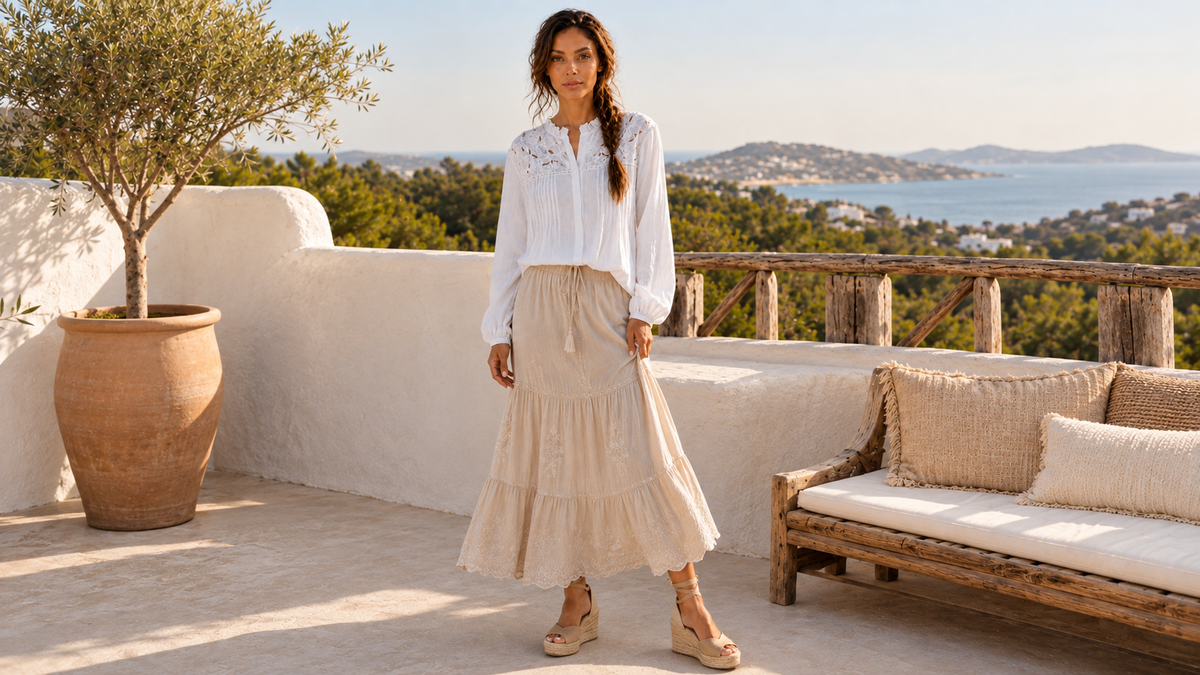
The Azahar Blouse has a mandarin collar with a ruffle, a guipure yoke, front pleats, and long balloon sleeves. The catalog photograph shows a suggestion with a light-colored skirt: it helps to see how a partially visible waist separates the blouse body from the bottom flare. You can apply that idea to a skirt from your own closet, without looking for an identical set.

With this blouse, try the skirt first without adding a necklace: the collar and yoke already occupy that area. If you are looking for an autumn version, change the sandals in the photograph for your closed footwear and check the length again. The image serves as a reference for proportions, not as an obligation to use the same accessories.
The Bougainvillea Guipure Blouse proposes another relationship: it has short balloon sleeves, a central guipure panel, and is described as hip-length. Its shorter body allows you to try it loose over a defined-waist skirt. Observe where the panel ends before tucking in the front; preserving the complete design can be more interesting than showing the waistband.
Distribute color between two large surfaces
A chocolate skirt and a white blouse clearly mark the change between top and bottom. If you prefer a soft transition, try an ecru skirt with a light-colored blouse, comparing the shades together. White and ecru can coexist: the difference can be part of the outfit and does not require all fabrics to match exactly.
With a patterned skirt, first locate the background color and then one of its secondary colors. You can relate the blouse to any of them. If the embroidery also contrasts, observe the outfit from a distance: you might prefer to keep the bag plain so that both patterns are read without adding a third.
To expand your palette, check out these five color combinations for autumn. Here, the most useful choice is deciding which surface you want to highlight: the skirt for its color or the blouse for its detail. Both options work, but they call for different accessories.
Resolve footwear and jacket with the skirt on
The shoe must remain compatible with the hem when you take a step, not just when you pose. If you change sandals for ankle boots, observe if the skirt rests on the boot shaft or passes freely over it. Also, try the stairs: a hem that gets too close to the feet might force you to hold it up during the entire journey.
A short jacket leaves the meeting point between the skirt and blouse visible. A long one adds another layer and can accompany a continuous silhouette. What is best to avoid is choosing the jacket in isolation: if it ends right on the first ruffle or compresses the sleeves, the outfit will behave differently than you expected.
Also check the inner layer of sheer blouses. A different colored top can become a third stripe between the skirt and the neckline. Our guide on what to wear under a sheer blouse helps you decide on color, coverage, and length without taking transparency for granted.
A brief test before considering the outfit finished
- Walk a few steps and turn around to observe the full movement of the skirt.
- Sit down with the blouse positioned as you want to wear it and check the waist.
- Raise your arms to check how much the hem and the inner layer rise.
- Add the bag: check that it doesn't cover the detail you had chosen to highlight.
Doubts when combining a long skirt and a blouse
Do I need a belt if both garments are voluminous?
No. The belt adds a line and can take in volume, but it can also press on embellishments or make the blouse bulge. Try it only if you like that result and the skirt's waistband accommodates it comfortably.
Can I wear both garments with embroidery?
Yes. Compare the scale of the motifs and their position. A detailed yoke and embroidery on the skirt hem are kept separate; two borders that meet at the waist require a more careful test.
Should the blouse always be lighter?
No. A dark blouse with a light skirt reverses the contrast and can give prominence to the lower movement. Choose according to the actual garments and look at the ensemble with the jacket you will wear during your commute.