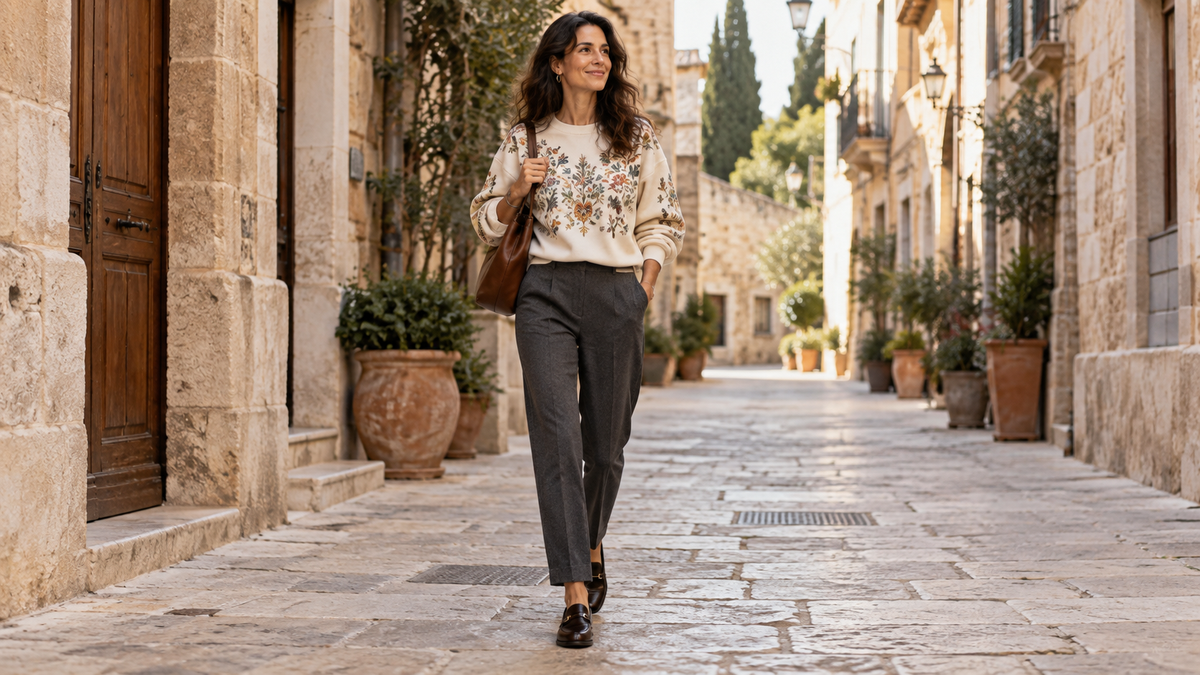
How to dress boho on a rainy day: layers, lengths, and footwear
To dress boho on a rainy day, first solve the protection for your journey and then incorporate the embroidery, color, or silhouette you like. A garment that looks like a coat does not guarantee waterproofing. Check the stated performance of the outer layer and footwear, and adapt the lengths to the route you are going to take.
You can keep a special blouse under an appropriate rain garment, choose a dress whose hem doesn't drag, or use pants with a boho-inspired top. The goal is to prepare an outfit that works when you leave, when you arrive, and during the planned activity, without depending on holding your clothes at every step.
The journey decides what remains exposed
Start with three questions: how much you will walk, where you will wait, and what you will carry in your hands. A short trip between doorways is not the same as walking with a bag, getting on a bus, or spending time outdoors. Check the forecast for your area and also consider the return trip.
Then identify which parts of the outfit would be outside the outer layer. These could be a long skirt, the cuffs of a blouse, a voluminous collar, or the top of the bag. That observation helps decide if you need to change the length, find another way to carry the accessory, or use a different outer garment.
An umbrella can be part of the solution, but check how you will handle it along with your bag and whatever else you need to carry. Do not build the outfit assuming it will keep any garment dry in any circumstance. When you have to fold it, you need a way to carry it that doesn't put moisture in contact with the rest of your things.
The outer layer: verify its function before combining colors
Choose your outer protection based on the manufacturer's information and the expected conditions. Do not attribute water resistance to a jacket just because it is thick, dark, or has a shiny surface. Nor does an embroidered garment acquire that function by being worn over another; design and performance are different matters.
Once you have chosen the appropriate garment, try it on over your inner outfit and close it the way you will wear it outside. Check the space in the shoulders and arms, the length of the hem, and the position of the sleeves. If you need to wear it open to be comfortable, check if that way of wearing it still suits your journey.
To integrate the boho aesthetic, you can repeat a tone from your inner outfit in a simple accessory or let the interest appear when you take off the outer layer. You don't have to show all the embroidery while you walk. A functional base on the street can coexist with a more expressive outfit upon reaching your destination.
Dresses: the useful length is tested by walking
A hem that stays off the floor in front of the mirror can get closer to it when you step down a curb, bend your knees, or wear different footwear. Put on the pair for the day and walk with your outer layer closed. Also observe any tassels or ends that hang: they are part of the effective length, even if the skirt ends higher up.
If the dress requires you to lift it constantly, try another one with a different length for that route. You don't always need to give up on long dresses, but you do need to test them in the specific situation. The guide on boots with long dresses can help you evaluate the shaft height, length, and relationship with the hem.
The Sereno Short Dress offers another starting point if you want a short option. According to its product page, it features a shirt design, front beading, and voluminous sleeves. Check where it ends on you and how it works with the tights or base layers you want to wear and with your outer garment.

A short length prevents the skirt from being near the ground, but it does not in itself solve the protection or comfort of your legs. Decide on the complete outfit according to your preferences and the day's conditions. If you are not convinced by the footwear you need, a combination with pants may be easier for that plan.
Pants and blouse: an alternative for frequent travel
If you are going to go in and out of several places, try pants whose hem stays off the ground with your chosen footwear. A wide leg can also work, although it is worth observing how much it moves and where it ends. Pants that drag do not become practical for rain just because they are a dark color.
The Azahar Blouse can add a boho detail indoors, combined with plain bottoms. Its guipure yoke and balloon sleeves require you to decide on the coverage you want and check the slack under the outer layer. It is not intended as protection against water, but as part of the outfit worn underneath.
Test the cuff with your arm bent and your hand holding your bag. If it sticks out too much from the outer sleeve, check another combination before leaving. Avoid creating an uncomfortable lump by pushing all the volume upward; the space between layers should allow movement without forcing you to readjust it continuously.
For a specific proposal, you can combine a light-colored blouse, black pants at an appropriate length, and footwear suitable for the route. If you prefer more color, incorporate it into an inner garment you already own. You don't need to add fringes, a decorated bag, and various jewelry for a detailed blouse to retain its character.
Footwear and bag: two decisions that change the outfit
Choose footwear based on its performance, its condition, and your experience using it. Check that it allows you to walk comfortably and that the fit is appropriate for the route. Do not deduce water protection or performance on wet surfaces from the height of the shaft, color, or the appearance of the sole.
If you change your footwear upon arrival, test both versions of the outfit beforehand. The hem that works with boots may be too close to the ground with a flatter shoe. Bring the spare pair only when you can transport and store it reasonably; adding another pair should not complicate the whole commute.
For your bag, prioritize access, closure, and how you carry it. Check the specifications of the model if you need protection against water, without assuming it based on its apparent material. If you are going to place it under the outer garment, test its capacity and movement with its actual contents; not all sizes allow for that solution.
Also observe the contact of straps and clasps with the clothing's embellishments. A strap that usually works over a t-shirt may coincide with beading when you change garments. You can change its position or choose another bag for that day. Comfort appears in those relationships between pieces, not just in each one separately.
Upon arrival: prepare where to leave everything
Think ahead about where you will leave your umbrella and outer layer depending on where you are going. Avoid resting them while damp on the blouse or dress you are wearing underneath. If you need to carry an appropriate bag or cover to transport them, include it in your preparation without assuming that a space will be available.
If any garment gets wet, check its label before applying heat or treatments. Ornaments may require different considerations than the main fabric. For garments with that finish, the velvet care guide explains why it is advisable to start from the specific instructions instead of choosing a method based on appearance.
Common questions when the weather changes
Can I wear an embroidered jacket if it rains?
You can include it once you have resolved how to use and transport it without attributing undeclared protection to it. If it goes under another layer, check the space and friction. If it doesn't fit well or you can't carry it appropriately, choose another inner garment for that route.
Do I have to rule out all light colors?
No. You can use them in areas that will not be exposed or accept the care that wearing them implies. Decide based on the route and the garment. Changing a hem that drags is more useful than keeping that same length only in a darker tone.
What if it stops raining halfway through the day?
Prepare a comfortable version for when you remove the outer layer and decide how you will carry it afterward. Keep the footwear that responds to the rest of the plan. The ability to adjust the outfit makes it easier to continue the day without needing a second complete selection of clothing.