

Sant Joan in Ibiza: what to wear for the most magical night of summer
Fire, Sand, Water, and Dawn: The Real Practical Guide · By Martina
IN BRIEF
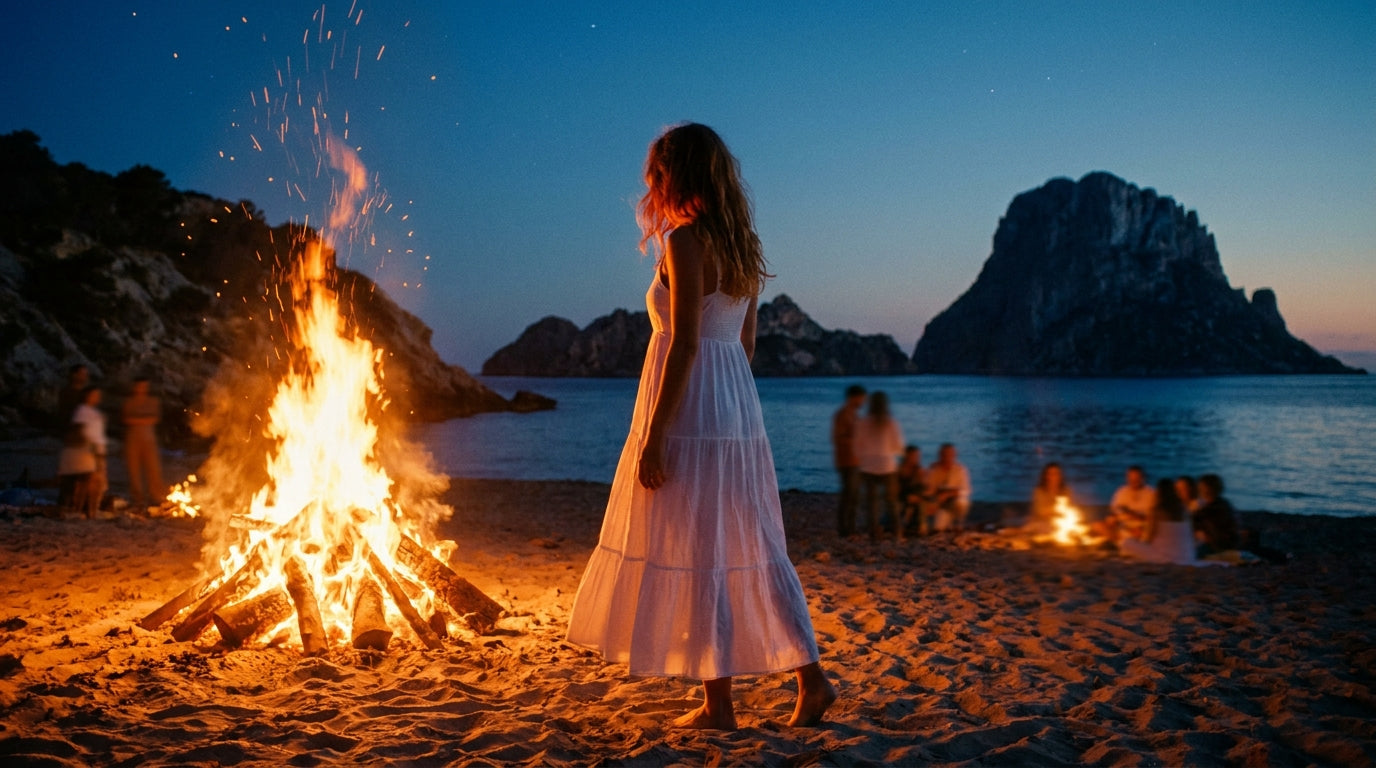
• The Nit de Sant Joan (June 23) combines four elements that influence your look: bonfire (sparks and smoke), sand (you sit on it), water (the ritual midnight swim), and dawn (temperatures drop).
• The winning formula: short or midi cotton or linen dress (NO synthetics near fire), that can get wet and dry quickly, a layer for dawn, flat shoes you can easily remove.
• White is the traditional color for Sant Joan: it symbolizes purification and renewal. It's the night of the year when the Ibizan white dress code makes the most ritual sense.
• Main mistake: dressing for Sant Joan as if it were an Ibizan finca party. It's not. It's a beach, fire, and sand party: your outfit needs to survive that.
The first Nit de Sant Joan I spent in Ibiza taught me more about dressing for that night than any guide. I arrived at Benirràs beach in a beautiful, brand-new long linen dress. By eleven at night, the hem was full of wet sand, I had a small spark burn on the skirt, and at one in the morning, when everyone went into the water for the ritual swim, I stayed on the shore because I didn't want to soak my dress. I missed half the party by being "too well-dressed."
The following year, I did the opposite: a short cotton dress I didn't mind getting wet, a thin layer in my bag for dawn, and old espadrilles I left by the towels. That night, I truly experienced it all: I jumped the bonfire, swam at midnight, and danced until four. The dress survived, and the night was perfect.
That's the core lesson of this guide: Sant Joan is not about dressing for a photo; it's about dressing for the ritual. And the ritual includes fire, sand, seawater, and the early hours of the morning. Everything else follows from there.
What is the Nit de Sant Joan (and why it dictates your outfit)
The Nit de Sant Joan is celebrated on the night of June 23, coinciding with the summer solstice. It is one of the oldest festivities in the Mediterranean: a mix of pagan tradition (the cult of the sun and fire) and Christian celebration (the eve of Saint John the Baptist). In Ibiza, the Balearic Islands, along the entire Spanish Mediterranean coast, and in Galicia, it is THE night of the year.

The traditional rituals are three, and all three affect your clothing:
-
1. The bonfire. Bonfires are lit on beaches and squares. Tradition dictates jumping over the bonfire (three, seven, or nine times depending on the area) to purify oneself and attract good luck. This means: sparks, smoke, radiant heat, and sudden movement. Synthetic fabrics near fire are literally dangerous (they melt); linen and cotton resist much better.
-
2. The midnight swim. At midnight, tradition is to go into the sea to purify oneself with the "waters of Saint John." In Ibiza and many beaches, this is actually done. If you want to experience the full ritual, your outfit needs to be able to get wet or be quickly removed.
-
3. The long dawn. Sant Joan doesn't end at midnight; it begins. The party continues on the beach until dawn. The temperature by the sea can drop to 17-18 degrees Celsius (62-64 Fahrenheit) at 4 AM. Without a layer, you'll leave early.
In Ibiza, the beaches with the most Sant Joan tradition are Benirràs (with its legendary drums), ses Salines, Cala Sant Vicent, and platja d'en Bossa. The town of Sant Joan de Labritja also celebrates its patron saint's day with a street party. But the ritual is the same in Alicante, Valencia, Barcelona, Cadiz, or La Coruña: bonfire, sea, and dawn.
The Sant Joan code: ritual white, lively fabrics
Sant Joan has its own color code that directly connects with the Adlib tradition: white. It's not a coincidence or a fashion trend. White on the night of San Juan symbolizes purification and renewal, the two central concepts of the solstice. Dressing in white for Sant Joan is participating in the ritual, not just the aesthetics.

But unlike a white party at a country estate, Sant Joan's white is a "lively" white: it will touch sand, smoke, salt spray, and possibly seawater. This changes the choice of garment:
-
Fabrics: cotton and linen, without exception. They are the only ones that resist near fire, get wet without getting ruined, and dry in the night air.
-
Length: short or midi. A long dress on the sand at night is a trap: it drags, gets wet at the waterline, collects damp sand, and becomes heavy.
-
Structure: the simpler, the better. No rhinestones (they'll get lost in the sand), no extremely delicate embroidery (salt spray and smoke will damage them), no "brand new" pieces you're afraid to ruin.
-
The ultimate criterion: if you're not willing for that garment to end up with sand, smoke, and salt spray, it's not the garment for Sant Joan.
The complete look, piece by piece
The dress
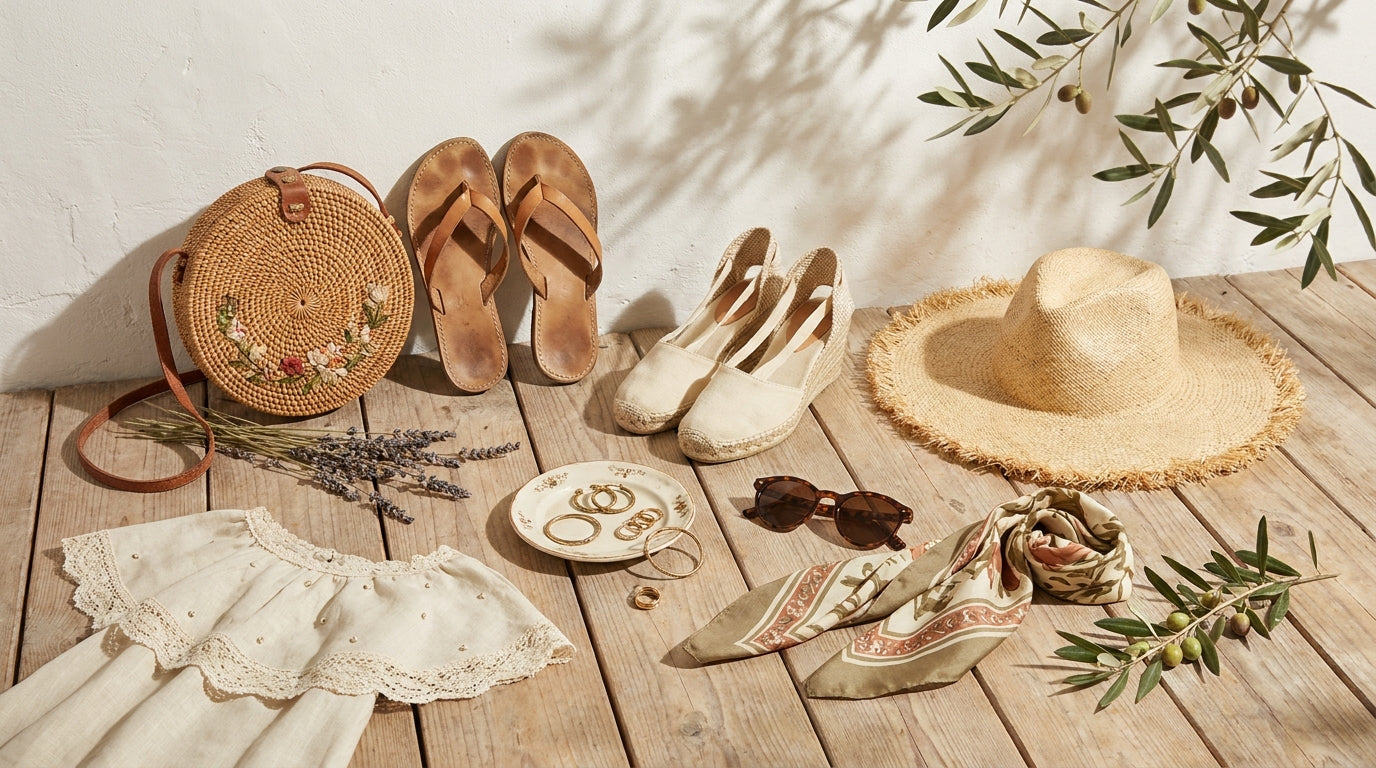
Short or midi dress in organic cotton or linen, white or off-white, with a simple and comfortable cut. Wide straps or short sleeves (very thin straps suffer with the movement of jumping the bonfire). If it has embroidery, it should be robust (thread embroidery, not rhinestones). A short cotton tunic also works perfectly and is even more practical over a swimsuit.
The secret: swimsuit underneath
The number one Sant Joan trick: wear your swimsuit or bikini under your dress from home. In natural colors (beige, off-white, terracotta). When the midnight swim arrives, you take off your dress and go into the water without any fuss. When you come out, your cotton dress acts as an improvised towel until you dry off by the bonfire.

The dawn layer
Essential. Not a hoodie (it breaks the whole code), but yes: a thick cotton caftan, a thin off-white cotton sweater, a loose linen shirt to layer, or a large cotton sarong that doubles as a shoulder blanket. It goes folded in your bag until 2 AM, and from then on, it's the most valuable item of the night.
Footwear
Old espadrilles or flat sandals you don't mind getting sandy. You'll end up barefoot half the night (the sand at night is pleasant, and the swim requires it), so footwear is basically "to get there and to leave." No wedges, no delicate sandals, nothing new.
The bag
Medium jute or fabric beach bag that can be left on the sand without worry. Inside: the layer, a small microfiber towel, hair ties, lip balm, phone in a waterproof bag, and some cash. No fancy bags: it's a night of sand and fire.
Hair and makeup
Hair down at first, hair tie handy for dawn (salt and humidity will curl it anyway: accept it as part of the ritual). Minimal, waterproof makeup if there's going to be a swim: Sant Joan photos with a fresh face from the sea and the light of the bonfire are the best of summer precisely because they are real.
The 5 classic Sant Joan mistakes
New long dress. Long + wet sand + sparks = dress suffering all night and you worrying about it. The night is meant to be lived.

-
2. Synthetic fabric near the bonfire. It's not just aesthetics: polyester melts with a spark and can cause serious burns by sticking to the skin. Near fire, only natural fibers. This is the most important safety rule of the night.
-
3. Going without a layer "because it's June." The temperature difference between 10 PM and 4 AM by the sea is 10-12 degrees Celsius (18-22 Fahrenheit). Every year, half the beach leaves by 2 AM shivering. The other half brought a layer.
-
4. Good shoes or heels. The sand eats everything. And half the night you'll be barefoot. Old espadrilles or basic sandals.
-
5. Not wearing a swimsuit underneath. When the midnight swim arrives and you're not wearing one, you have two options: miss the ritual or improvise. Both are worse than having worn it.
If your Sant Joan is not in Ibiza
The Nit de Sant Joan is celebrated all along the Spanish coast, and the code is essentially the same, with local nuances worth knowing.
In Alicante, Sant Joan is THE party of the year (Les Fogueres de Sant Joan, declared of International Tourist Interest): besides the beach, there's an urban street party, so the look can be slightly dressier for the city part. In Valencia and Barcelona, the beach celebration is massive: same code as Ibiza, more crowds, better to carry minimal items. In Galicia (where it's San Xoán), the night is cooler: the layer goes from recommended to essential, and the "sardiñadas" (sardine parties) by the bonfire add extra smoke to the look. In Andalusia (the "Juanillo" in Cadiz), the atmosphere is pure beach: identical Ibizan code.
The essence doesn't change: fire, sea, dawn, ritual white, and natural fabrics. If you dress for these four elements, you'll get it right anywhere along the coast.
If you're looking for the cotton or linen dress that will survive (and shine) on a Sant Joan night, in our collection of Ibizan party dresses you'll find the most resistant and vibrant white pieces in the catalog: those designed to be actually worn, not just admired.
Frequently asked questions about the night of Sant Joan
What color should I wear for Sant Joan?
White is the traditional color for the Nit de Sant Joan: it symbolizes purification and renewal, the central concepts of the summer solstice. It's not mandatory, but on traditional beaches (especially in Ibiza and the Balearic Islands), most people wear white or off-white. It's the night of the year when the white dress code makes the most ritual sense.
Can I wear a long dress to the bonfire of San Juan?
You can, but it's not recommended. A long dress on the beach at night will drag through wet sand, become heavy, collect salt spray, and be exposed to bonfire sparks. A short or midi dress in cotton or linen is the practical option that allows you to experience the full ritual: jumping the bonfire, sitting on the sand, and swimming at midnight.
What fabrics are safe near a bonfire?
Only natural fibers: mainly cotton and linen. Synthetic fabrics (polyester, nylon, acrylic) melt with sparks and can cause burns by sticking to the skin. This is the most important safety rule of the night: near fire, nothing synthetic.
What does the midnight swim of San Juan consist of?
Tradition dictates going into the sea at midnight on June 23 to purify oneself with the "waters of San Juan." In some areas, people jump over nine waves; in others, simply getting wet is enough. The practical trick: wear a swimsuit or bikini under your dress from home and experience the ritual without improvising.
How many times should one jump the bonfire of San Juan?
It depends on local tradition: three times in most areas of the Mediterranean coast, seven in some localities, and nine in the Galician tradition of San Xoán. In all cases, the meaning is the same: fire purifies and burns away the bad of the year ending with the solstice.
Where is Sant Joan celebrated in Ibiza?
The beaches with the most tradition are Benirràs (famous for its sunset drumming), ses Salines, Cala Sant Vicent, and platja d'en Bossa. The town of Sant Joan de Labritja also celebrates its patron saint's day with a street party. Generally, almost any beach on the island will have a bonfire and celebration that night.
What should I bring in my bag for the night of San Juan?
A cotton layer or caftan for dawn, a small microfiber towel, hair ties, lip balm, your phone protected in a waterproof bag, and some cash. The bag: jute or fabric, one you don't mind getting sandy.
About the author
Martina is the founder of Martina Ibiza, a contemporary Adlib fashion brand based in Spain. She has been working for years with family workshops in Ibiza and the mainland to create artisanal dresses in linen, crochet, and hand embroidery within the authentic Adlib code. Here, she shares what she learns from the trade.
%20combines%20four%20elements%20that%20influence%20your%20look:%20bonfire%20(sparks%20and%20smoke),%20sand%20(you%20s...)