
Adlib Fashion: The True Story (Not the Wikipedia Version)
From Smilja Mihailovitch to 2026: Fifty Years of a Unique Dress Code · By Martina
IN BRIEF
• Adlib fashion was born in Ibiza in 1971, spearheaded by Smilja Mihailovitch, a Yugoslav aristocrat married to a Polish nobleman, who had been a refugee on the island since the 1960s.
• The foundational first fashion show was held in May 1971 at the Es Cubells estate, with Smilja as organizer and local designers like Yamamay.
• The name "Adlib" comes from the Latin "ad libitum" (at one's pleasure). It signifies creative freedom within a minimal code: white, craftsmanship, fluidity.
• In 55 years, Adlib fashion has gone through four stages: foundational (1971-1985), industrialization (1985-2000), global expansion (2000-2015), and contemporary revival (2015-present).
There is a version of the Adlib story that is repeated in every fashion blog, every tourist magazine, and every Ibiza guide. It tells the same tale: that it was born in 1971, that Smilja created it, that it comes from Smilja Mihailovitch, and that the motto was "ad libitum." It's a correct but skeletal version. It lacks the real people, the contexts, the concrete decisions, the anecdotes that explain why this code still exists fifty-five years later.
I have been collecting information on the history of Adlib for years: talking to people who lived through the early years, reviewing archives, reading old books about Ibiza, interviewing relatives of the protagonists. This guide is the closest to the complete story I have been able to assemble. It is not perfect (many protagonists are no longer alive to corroborate) but it is honest and verifiable.
If you have ever worn an Ibizan dress to a wedding and wondered where exactly that aesthetic comes from, this is the long answer. It's a story with aristocrats, dictatorships, hippies, artists, and an extraordinary woman with a very clear vision of what she wanted to do.
Who was Smilja Mihailovitch (the woman behind Adlib)
Smilja Mihailovitch was born in Belgrade in 1921, into a Yugoslav aristocratic family with connections to the Serbian royal court. Her full name was Smiljana Mihailović. She belonged to a generation of Central European aristocratic women who grew up between the two world wars, speaking several languages, educated in art and classical culture, with social networks that extended throughout Europe.
 Evocative atmosphere of the 70s in an Ibizan finca with original Adlib dresses
Her life changed radically with the Second World War and the subsequent establishment of Tito's communist regime in Yugoslavia. The Yugoslav aristocracy lost property, status, and in many cases, had to go into exile. Smilja left the country and settled in Paris, where she married Egon von Fürstenberg-Hedringen, a Polish aristocrat. The couple lived for several years in sophisticated European circles.
In the 1960s, Smilja discovered Ibiza. She did so through the European art circuits that had already begun to arrive on the island, seeking refuge from the urban cultural establishment. She bought a property near Es Cubells, on the southwest coast of the island, one of the most spectacular and isolated areas. There, she began to host her European friends: artists, writers, aristocrats looking for something different.
HISTORICAL FACT
Smilja Mihailovitch passed away in 1994. She is buried in the cemetery of Sant Josep de sa Talaia, in Ibiza. Her grave has become a small informal pilgrimage for Adlib fashion lovers.
What differentiated Smilja from other exiled aristocrats was not her refined taste (that was common in her class). It was her ability to transform refined taste into a cultural project. She had a very clear vision: Ibiza had a beautiful textile tradition (the peasant costume, artisanal embroidery), a unique environment (the light, the sea, the white fincas) and a burgeoning cosmopolitan community. If someone knew how to combine them, they could create something new.
The context that made Adlib possible (Ibiza 1965-1970)
Adlib did not arise out of nowhere. It was born at a very specific moment in Ibiza's history that is worth understanding because it explains why the code is the way it is.

Vintage image of Ibiza in the 70s with traditional artisans embroidering peasant costumes
In the 1960s, Ibiza was the European destination for three very different types of refugees. First, American hippies fleeing the Vietnam War and the repression of the Nixon era. Second, Central European intellectuals and artists (Germans, Austrians, Swiss) seeking alternatives to post-war society. Third, Spanish deserters from Franco's regime, who found Ibiza to be a relatively more permissive area than the rest of the country due to its distance from Madrid and the already established presence of foreigners.
This mix generated a very particular cultural society. On the one hand, the island maintained its rural peasant tradition (traditional dress, embroidery, agriculture, closed family communities). On the other, it received a constant influence from cosmopolitan people with a different aesthetic. The friction between these two traditions produced the breeding ground from which Adlib would be born.
Smilja captured this friction better than anyone. She saw that peasant craftsmanship (embroidery, lace, linen) could be updated for a cosmopolitan clientele without losing its identity. And that the cultural freedom of the island allowed for a dress code that did not exist anywhere else in Europe: relaxed yet elegant, artisanal yet modern, traditional yet adaptable.
The Foundational Fashion Show of 1971
The foundational event of Adlib fashion was a show organized by Smilja Mihailovitch in May 1971 at her estate in Es Cubells. The exact date varies according to sources (some say April, others May, some June), but the consensus is that it was during the spring-summer of that year.

Atmospheric recreation of the foundational Adlib fashion show of 1971 at an Es Cubells estate
The fashion show brought together several local and European designers and artisans living on the island. Among them, Yamamay (Ana María Bustinduy) stood out, a Basque designer based in Ibiza since the 1960s, who was already working with traditional fabrics and peasant embroidery. Other less known but equally influential creators also participated: Tina Tarot, Charo Ruiz (yes, the Charo Ruiz Ibiza brand that is still active today was founded in 1971 directly linked to this movement) and several local artisans who contributed their traditional techniques.
VERIFIABLE FACT
Charo Ruiz Ibiza, one of the oldest brands still active within the Adlib code, was founded in 1971, the year of the foundational fashion show. It continues to be managed by the Ruiz family since then, maintaining the original spirit.
The concept of the fashion show was revolutionary for its time. Instead of presenting collections with clear hierarchies (haute couture, prêt-à-porter), Smilja proposed a common code: white as the base, natural fabrics (linen, cotton, crochet), artisanal embroidery as the hallmark, and creative freedom for each designer to interpret within the framework. Hence the motto: "Ad libitum" (at will).
What was revolutionary about it was the concept of "open source" before the term even existed. In 1970s French haute couture, each house had its closed and exclusive identity. Adlib proposed the opposite: a collective identity based on shared principles, open to anyone who wanted to enter within the code. It's a very modern idea that in the 70s was almost avant-garde.
Stage 1: Foundational Adlib (1971-1985)
The first fourteen years of Adlib were a period of consolidation. Smilja continued to organize annual fashion shows at her estate. The international press began to take notice (Vogue dedicated a report in 1974, which was key to internationalizing the concept). Buyers from boutiques in Paris, Milan, and New York arrived. Ibizan designers sold outside the island for the first time.

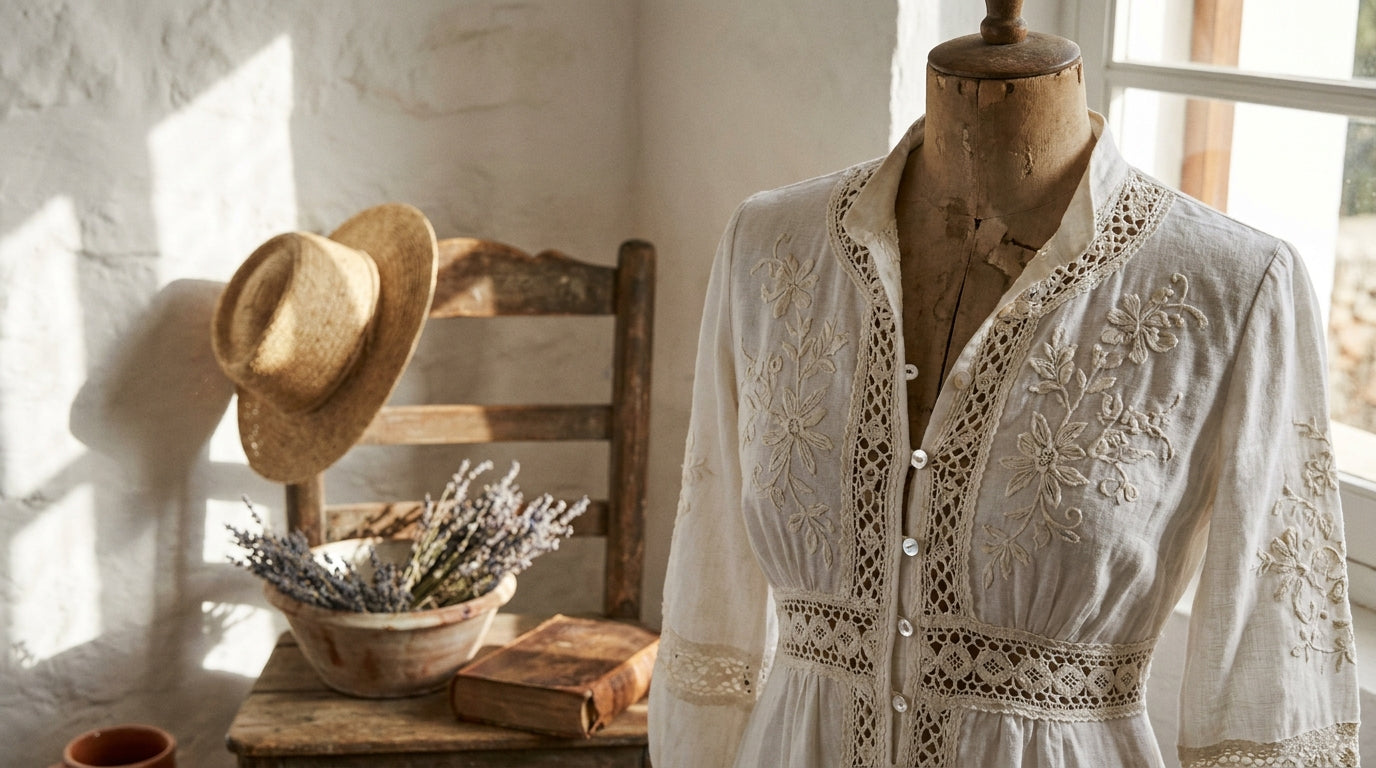
Detail of traditional Adlib embroidery on white linen using artisanal technique
The code in this stage was very strict. Absolute white. Mandatory artisanal embroidery (no machinery allowed). Exclusively natural fabrics. Local production in family workshops in Ibiza. It was almost a manifesto against the industrialization of fashion. The visual aesthetic was associated with the iconic photographs of the island: white walls, white dresses, golden light.
This is the stage where the codes that are still valid today were established. If you look at an Adlib photograph from 1975, you might confuse it with one from 2025 at first glance. The visual grammar was established during these years.
Stage 2: Industrialization (1985-2000)
In the mid-1980s, Adlib transitioned from a local movement to a commercial category. The original brands professionalized. New companies emerged that adopted the code (Hippy Chick Ibiza, Tony Bonet, El Naturalista Ibiza, among others). Embroidery began to mix: partly handmade, partly machine-made. Some workshops moved to other areas of Spain (Galicia, Catalonia) and even India and Morocco to lower costs.
This period was ambiguous. On the one hand, Adlib fashion reached more people and became popular. On the other, it lost some of its original artisanal purity. Smilja Mihailovitch passed away in 1994, leaving the movement without its foundational figure and opening the debate about who was the guardian of the code.
In 1999, the Consell d'Eivissa - Marca Adlib (also known as "Adlib Denomination of Origin") was created, an attempt to protect the name and original standards. It is the first formal institution to regulate what can be called "Adlib" and what cannot. It is still active today and annually certifies brands that meet the standards.
Stage 3: Global Expansion (2000-2015)
The 2000s marked the definitive expansion of Adlib. Three factors drove it: the tourist boom in Ibiza (from 2 to 4 million visitors annually in a decade), the consolidation of "white parties" as a commercial phenomenon (Pacha, Destino, Ushuaïa adopted the white code), and the arrival of Instagram (which transformed Adlib into a highly photographable aesthetic).
During this period, Adlib merged with other codes: boho-chic (broader, with colors), hippie-Goa (more ethnic), French bohemian. The original purity was commercially diluted but gained global reach. International brands (Free People, Anthropologie, Mango) launched "Ibiza collections" that adopted elements of Adlib without commitment to the original code.
This is the most controversial stage for purists. Some historical brands (Charo Ruiz, Yamamay) advocate fidelity to the foundational code. Others (Mauna, Hippy Chick) adopt the code but commercialize more freely. The general consumer begins to call any white dress with embroidery "Adlib," losing the precision of the concept.
Stage 4: Contemporary Revival (2015-Present)
Since approximately 2015, there has been a revival movement that returns to the foundational code. It is driven by three trends: the rise of slow fashion (consumers who value artisanal quality), the weariness of diluted boho fashion (a return to authenticity), and a new generation of designers with a clear historical consciousness.

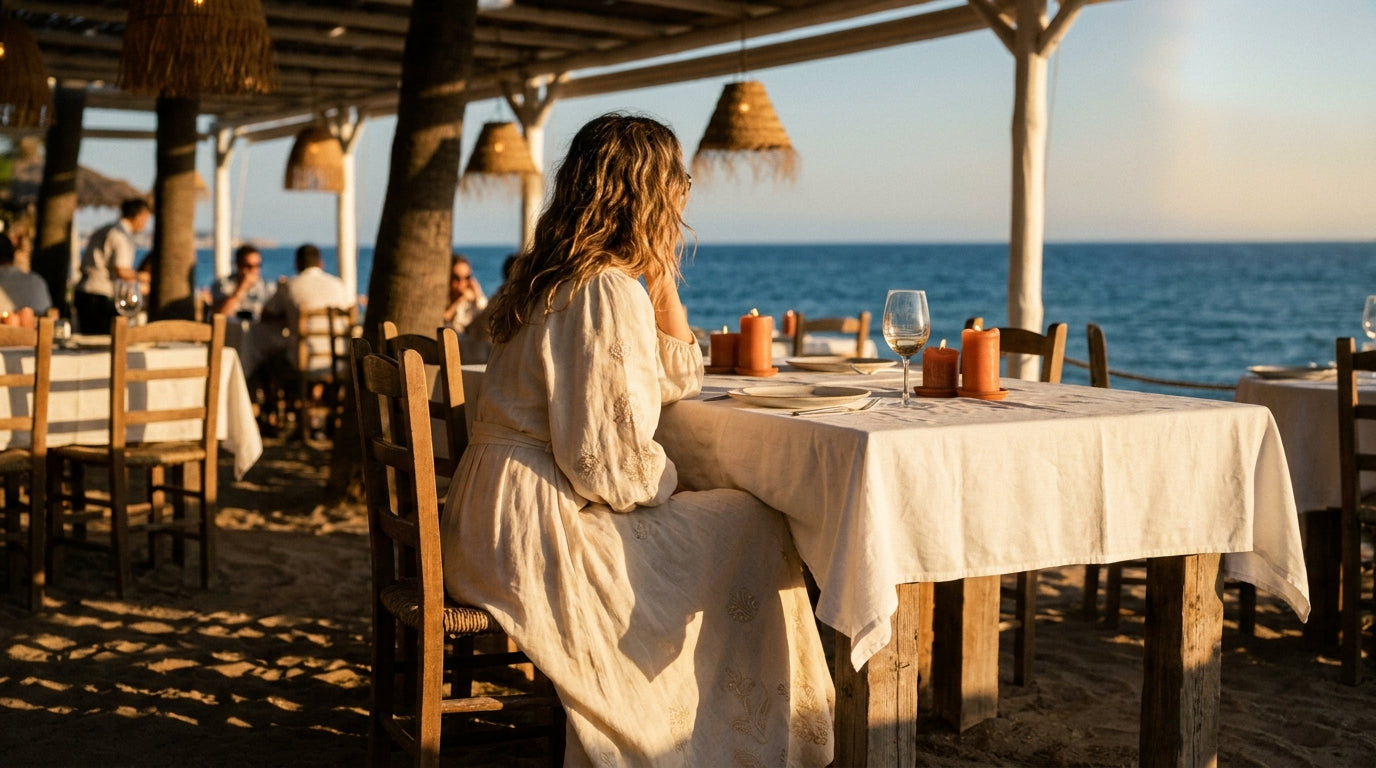
Modern woman in contemporary Adlib dress on an Ibiza finca at sunset 2026
In this stage, new brands emerge that explicitly position themselves within the original code. Martina Ibiza (the brand from which I am writing this article) is born within this movement. Other relevant brands of the current revival: Nekai Ibiza, R22 Ibiza, Polinesia, Anoei. All share a commitment to craftsmanship, chromatic fidelity, and the code of discreet Mediterranean luxury.
It is also the stage where Adlib finds clientele outside Ibiza for the first time systematically. "Ibizan style" weddings held in Madrid, Galicia, Andalusia, or even outside Spain multiply the reach of the code. This is the stage where Adlib definitively becomes a category of Mediterranean fashion, not just a local brand from the island.
CURRENT FACT
In 2026, the Consell d'Eivissa - Marca Adlib officially recognizes 8 brands with origin certification. Annual fashion shows continue to be held in Ibiza, now with international repercussions documented by Vogue, Harper's Bazaar, and specialized press.
The Four Principles That Remain Since 1971
Despite 55 years of changes, there are four foundational principles of Adlib that remain virtually intact. These are what differentiate an authentic Adlib piece from an imitation or a brand that only uses the name.
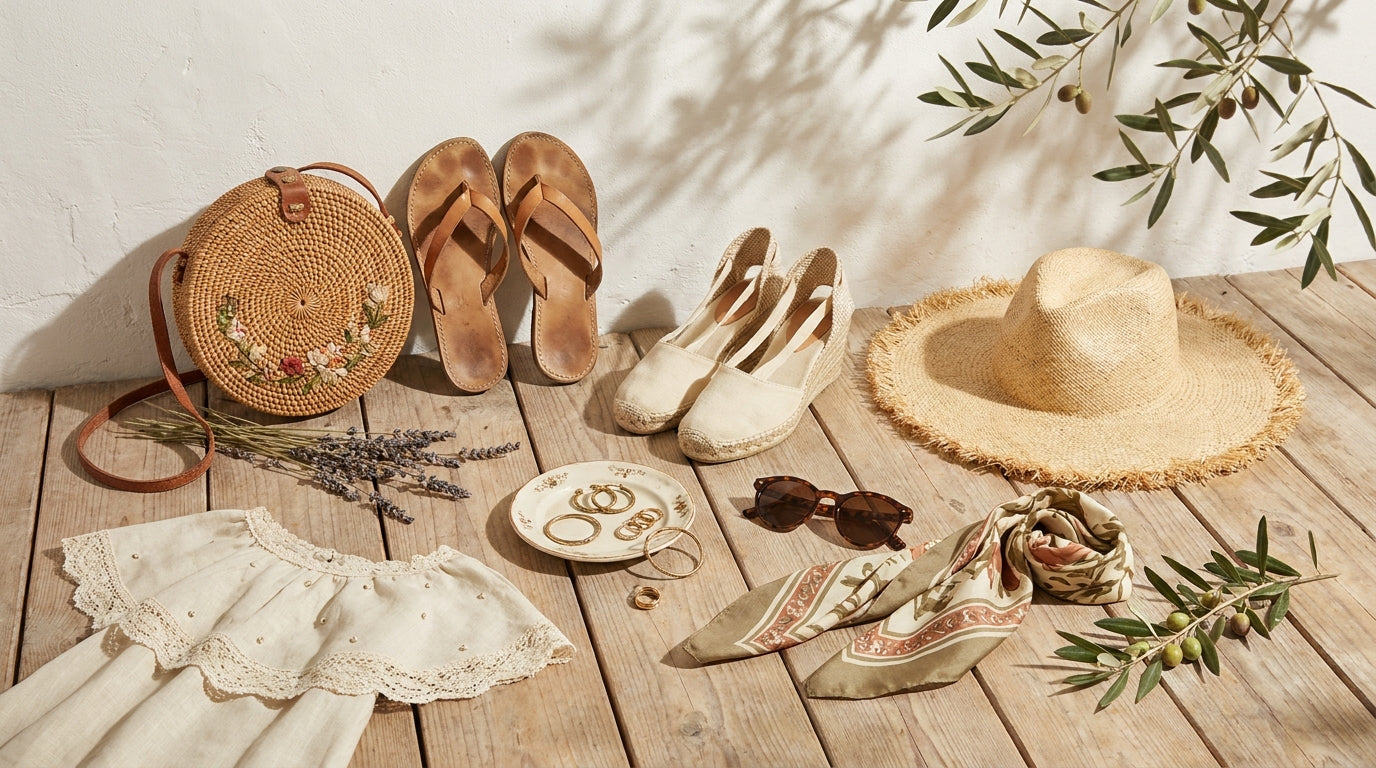
 Four editorial details showcasing the four pillars of the Adlib code: white, craftsmanship, linen, fluidity
-
1. White as the chromatic base. Variations (off-white, bone, ivory, vanilla, sand) are accepted, but the predominance of white is non-negotiable. Brands that deviate from this lose their Adlib identity, even if they retain other elements.
-
2. Visible craftsmanship. Hand embroidery, lace, crochet, sewn beads. It's not decoration; it's the signature of the code. Without visible craftsmanship, it's not Adlib.
-
3. Natural fabrics. Linen, organic cotton, crochet, fine silk, good quality viscose. Synthetics are outside the code and always have been.
-
4. Fluid drape. No rigid, artificially structured Adlib piece or one that doesn't move with the air. Fluidity is structural, not decorative.
If a garment meets these four principles, it is authentic Adlib, regardless of the brand, year, or price. If it fails in any of them, it belongs to another code (boho, broad contemporary Ibizan, generic Mediterranean, etc.).
Why it matters to know the history (beyond the cultural aspect)
There is a very practical reason to know this history that goes beyond cultural interest. When you understand where Adlib comes from, you can distinguish authentic from commercial without having to rely on the label.
Today, in 2026, there are thousands of brands selling "Ibizan style dresses" or "Adlib fashion." Most do not comply with the original code. Some use synthetic fabrics, others mass-produce without real craftsmanship, others stick to visual aesthetics without understanding the principles. If you only look at the label or the price, you can be mistaken.
But if you know the history, you can ask specific questions. Where does the fabric come from? Who does the embroidery? Is the brand certified by the Consell d'Eivissa? Is there historical continuity with the foundational movement? The answers to these questions will immediately tell you whether you have authentic Adlib or just inspired aesthetics.
That's why at Martina Ibiza we are transparent about this. We are in the contemporary revival stage. We recognize Smilja Mihailovitch as a foundational figure. We honor the four rules of the code. We work with family workshops in Ibiza and the Peninsula (not India or Morocco). Every piece has craftsmanship behind it. Not for marketing, but because we understand that without that historical continuity, what we do would not be Adlib; it would be something else.
If after reading the history you want to see how it translates into concrete pieces today, explore our collection of Ibizan dresses. Each piece is born from the craft that Smilja Mihailovitch helped invent 55 years ago. And if you want to see the most faithful to the spirit of the foundational parade (integral embroidery, absolute craftsmanship), the pieces from the Atelier collection are the ones that best represent that fidelity to the original code.
Frequently asked questions about Adlib fashion
Who created Adlib fashion?
Adlib fashion was created in 1971 in Ibiza by Smilja Mihailovitch, a Yugoslav aristocrat (born in Belgrade in 1921, died in Ibiza in 1994). Smilja organized the foundational fashion show at her estate in Es Cubells and brought together local designers such as Yamamay and Charo Ruiz. The name "Adlib" comes from the Latin "ad libitum" (at will), reflecting creative freedom within a common code.
What does "ad libitum" mean?
"Ad libitum" is a Latin expression meaning "at will" or "as one pleases." In classical music, it indicates freedom for the performer to vary the tempo or embellish the piece. Smilja applied it to fashion with a similar meaning: there is a common code (white, craftsmanship, fluidity, natural fabric) but within it, each designer has absolute creative freedom.
Is Adlib fashion the same as Ibizan fashion?
They are related concepts but not identical. Adlib fashion is the specific code born in 1971 with concrete rules (white, craftsmanship, linen, fluidity). "Ibizan fashion" is a broader term that includes Adlib but also traditional peasant dress, contemporary boho fashion, and all variants born in Ibiza. All Adlib fashion is Ibizan, but not all Ibizan fashion is Adlib.
Is there a designation of origin for Adlib?
Yes. In 1999, the Consell d'Eivissa - Marca Adlib was created, an institution that certifies brands that meet the original standards. It is the equivalent of a designation of origin for fashion. In 2026, it officially recognizes 8 certified brands. This certification implies production in Ibiza, use of natural fabrics, real craftsmanship, and respect for the chromatic code.
Where did the first Adlib fashion show take place?
The foundational fashion show was held in May 1971 at Smilja Mihailovitch's estate in Es Cubells, on the southwest coast of Ibiza. It brought together several local and European designers living on the island, including Yamamay (Ana María Bustinduy), Tina Tarot, and Charo Ruiz. It was the moment that laid the foundations for the entire movement.
Why is Adlib associated with the color white?
White was the base color of traditional Ibizan peasant dress (the white blouse of women's clothing). Smilja Mihailovitch chose it as the backbone of the code to create continuity with local tradition. In addition, white works exceptionally well with the Mediterranean light of the island and with traditional white-walled architecture. It is an aesthetic decision but also a cultural and geographical one.
Is Adlib fashion still made in Ibiza?
Partly yes, partly it has moved. The brands most faithful to the original code (Charo Ruiz, Yamamay, those certified by the Consell d'Eivissa) produce in Ibiza. Many commercial brands that use the aesthetic produce elsewhere (Galicia, Catalonia, India, Morocco). If authenticity matters to you, look for certified brands or those that are transparent about where and with whom they produce.
Does Smilja Mihailovitch have descendants who continue her legacy?
This is a question without a clear documented answer. Smilja passed away in 1994, and her legacy has been continued by the community of designers and certified brands, rather than by direct biological descendants. The Consell d'Eivissa - Marca Adlib acts today as the institutional guardian of the movement.
About the author
Martina is the founder of Martina Ibiza, a contemporary Adlib fashion brand based in Spain. She has been working for years with family workshops in Ibiza and the Peninsula to create handmade dresses in linen, crochet, and hand embroidery within the authentic Adlib code. Here she shares what she learns from the trade.
Note on sources
This article is based on information documented by the Consell d'Eivissa - Marca Adlib, archives of Vogue España, books on the cultural history of Ibiza (especially "Ibiza eternal" by Ferran Marí), informal interviews with people linked to the movement, and professional knowledge acquired over years of working with the craft. Some exact dates and specific names may vary depending on the source; in these cases, we have opted for the most documented version.