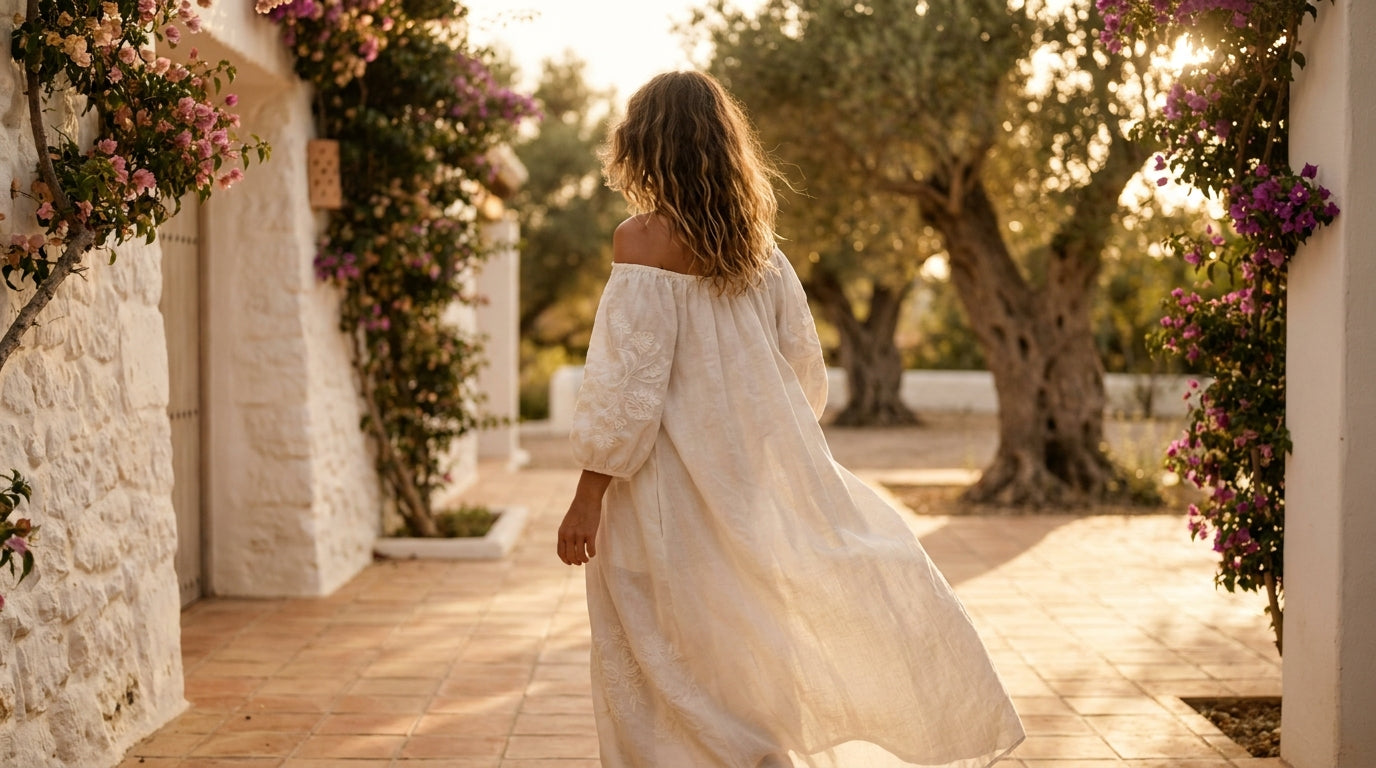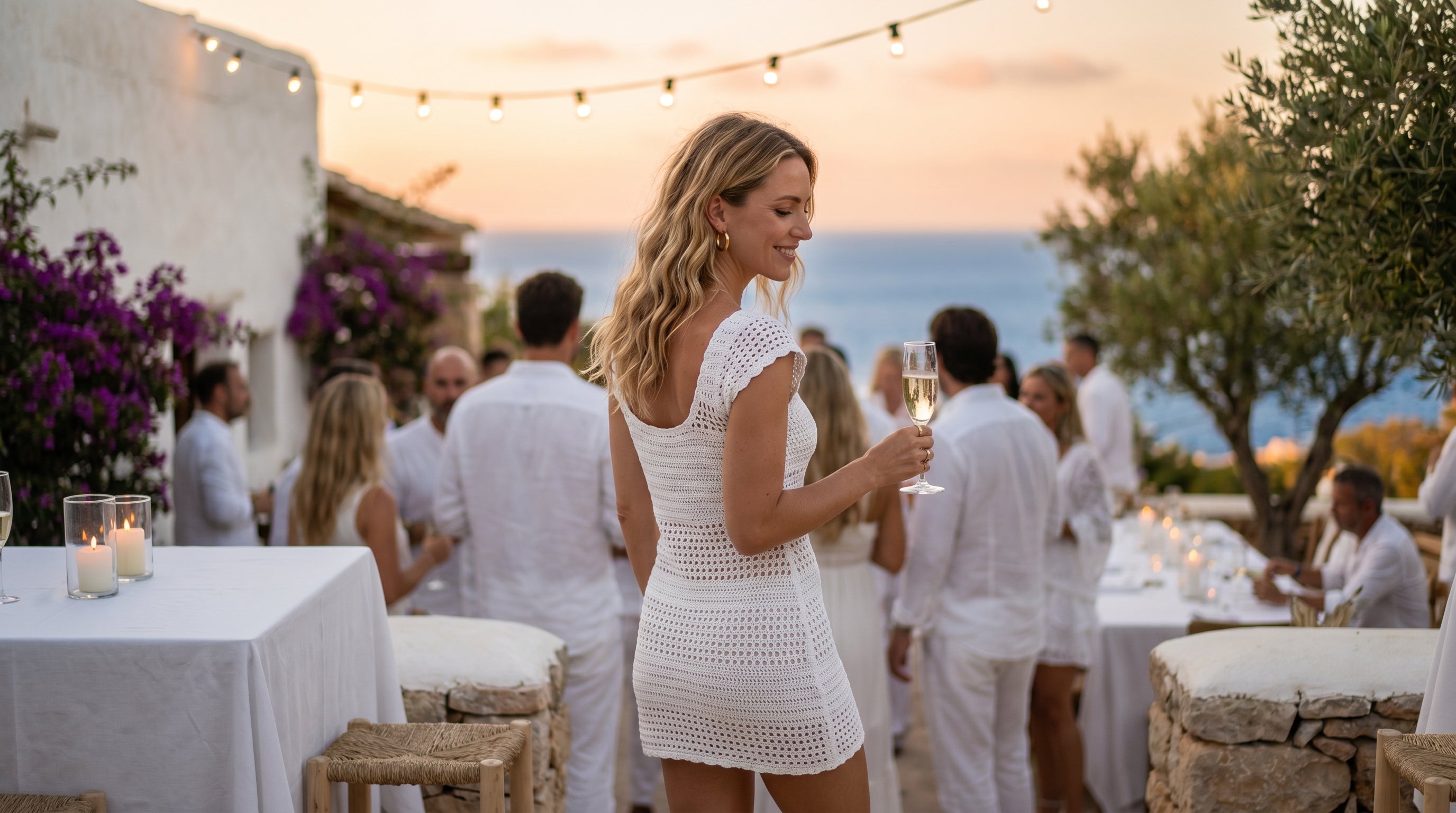

How to dress in Ibiza style without looking like you're in costume: the ultimate guide
What I learned about the Adlib code from the inside · By Martina
IN BRIEF
• Ibiza style is not "wearing white with embroidery." It is a chromatic and cultural code with roots in Adlib fashion created by Smilja Mihailovitch in 1971.
• There are 4 different sub-styles: traditional peasant, classic Adlib, contemporary Ibizan, and boho-Mediterranean. Confusing them makes you look like you're in costume.
• The real formula: natural fabrics (linen, crochet, organic cotton), white and earth tone palette, flowing drape, tasteful handcrafted details.
• The 5 most common mistakes: excess of "typical" elements, forced hat, synthetic fabrics, souvenir accessories, mixing Adlib with a hippie look.
A few summers ago, at Las Dalias, I saw a woman with a look that I remember perfectly because it was the exact example of what NOT to do. A loose white dress, espadrilles with ribbons up to the knee, an XL straw hat, several ethnic necklaces layered, ankle bracelets, a kimono with fringe, and a wicker market basket bag. Each piece, separately, could have been fine. Together, it was a "tourist dressed as an Ibizan for a themed party" costume.
I mentioned to a local friend who was with me what I thought. She told me something that stuck with me: "The worst part is that she probably thinks she's dressed like us. And she looks nothing like it."
That sentence summarizes the central problem of Ibizan style for those not from the island. The aesthetic is very photogenic, social media has popularized it, and everyone thinks they know how to wear it. But the real code is different from the cliché. And falling into the cliché, paradoxically, distances you from the true identity of Ibizan fashion.
This guide is what I have learned in the years I've been working with Ibizan fashion: the unwritten rules, the distinctions that matter, the nuances that only become apparent when you live close to the island and the craft. If after reading it, you dress in Ibizan style with adult judgment, instead of the Pinterest version, we will have done our job.
What Ibizan style really is (and why most people confuse it)
Contemporary Ibizan style is not just one thing. It's the evolution of four currents that coexist on the island and blend to such an extent that many people treat them as synonyms. Knowing how to distinguish them is the first step to dressing well.
 Four styles of Ibizan fashion: traditional peasant, classic Adlib, contemporary Ibizan, and boho-Mediterranean
1. Traditional Peasant Style
This is the traditional regional costume of the Ibizan peasant woman: black gonella, white blouse, shawl, filigree gold jewelry, braided hairstyle. It is a formal and ceremonial costume that is still used in patron saint festivals like Sant Joan or Sant Bartomeu. If you wear it to a wedding in August without being a peasant, you're in costume. Period.
2. Classic Adlib (1971-2000)
What most people know as "Ibizan style" has a precise origin and date. It was created by Smilja Mihailovitch, a Yugoslav aristocrat based on the island, in 1971. Its foundational motto was "Ad libitum" (Latin for "at will" or "as you please"), from which the name Adlib comes. She conceived it as a modern reinterpretation of the peasant costume, maintaining the white, craftsmanship, and freedom of cut, but adapted to a cosmopolitan society. It is the code that remains the basis of Ibizan style.
3. Contemporary Ibizan (2000-present)
It is the evolution of classic Adlib towards more current silhouettes: more fitted dresses without losing the flowing drape, broader palettes (including earth tones, terracotta, sage), fabrics like crochet or linen mixed with elastane. Handmade embroidery is maintained but sometimes incorporates contemporary design, not just traditional motifs. This is where brands like Martina Ibiza are located.
4. Boho-Mediterranean
This is a broader aesthetic that takes elements from Ibizan style but mixes them with Moroccan, Greek, and Goa hippie influences. It allows for colors, prints, layers, and ethnic accessories. It's very photogenic but it's no longer strictly Ibizan; it's boho-Mediterranean. Mixing it with classic Adlib is what produces the "costume" effect we discussed.
Where all this comes from: the story almost no one tells
Adlib fashion didn't appear out of nowhere. It was born in a very specific context that is worth knowing because it explains why the code is the way it is.
 Detail of traditional Adlib dress with hand embroidery on white linen
In the late 1960s, Ibiza was a refuge for artists, intellectuals, and hippies who came to the island seeking an alternative to the mainstream. Smilja Mihailovitch, a former Yugoslav aristocrat married to a Polish nobleman, lived between the island and cosmopolitan European circles. In 1971, she organized a fashion show at her estate in Es Cubells along with Ibizan designer Yamamay and other local creators. The idea: to present fashion that captured the island's spirit of freedom and elevated it to the category of a brand proposal.
The motto "Ad libitum" was no coincidence. In classical music, "ad libitum" means that the performer has the freedom to vary the tempo or adorn the piece at their discretion. Applied to fashion, it meant: dress as you wish, but with taste. Without uniforms, without strict seasons, with the only rule of white as a base and craftsmanship as a technique.
Five decades later, that philosophy remains valid and is what separates those who dress in Ibizan style with good judgment from those who dress in cliché. Freedom is not the absence of a code. It is knowing the code so well that you can play with it.
The contemporary Ibizan style formula, broken down
If I had to reduce the current code to its essential elements, I would do it like this. Four pillars. Each with its own rules.
Pillar 1: Natural and handcrafted fabrics
Linen, organic cotton, crochet, fine silk, good quality viscose. Fabrics that breathe with the skin, that move with the wind, that show natural marks with use (wrinkles, folds, slight displacement) without looking messy. Synthetics are out of the code. Heavy fabrics are also out. If a garment doesn't move on its own in a breeze, it's not Ibizan, it's from a magazine.
Pillar 2: Mediterranean color palette
White is the backbone. Accompanied by off-white, bone, ivory, vanilla, beige, sand, soft terracotta, very diluted sage, very light gray. Touches of color are allowed but in embroidery or details, not as the main focus. Black exists but is a minority, almost always in accessories or Atelier pieces. Fuchsia, emerald green, cobalt blue, or any saturated color fall outside the code.
Pillar 3: Fluid drape and natural silhouette
Garments must move. Wide drape from the neckline, full skirts, thin straps, wide sleeves or sleeveless. Anything that binds, rigidly cinches, or artificially structures the silhouette doesn't work. This doesn't mean everything has to be very wide: there are fitted Ibizan dresses at the waist, but the lower drape always has volume. The mental rule: if the wind doesn't move it, it's not Ibizan.
Pillar 4: Tasteful handcrafted details
Hand embroidery, lace, handmade crochet, individually sewn beading. Industrial details (glued appliqués, massive sequins, visible machine embroidery) are out. The rule: if the detail doesn't involve a craft, it doesn't add anything. And one well-made handcrafted detail is better than five applied haphazardly.
The 5 most common mistakes I see every summer
After years of working with clients, there are mistakes that repeat with surprising frequency. If you recognize any of them as your own, it's not to beat yourself up: it's to correct them.
 Comparison of two styles: on the left, a look with too many elements; on the right, a minimalist Ibizan look
-
1. Accumulating "typical" elements to look more Ibizan. White dress + hat + ethnic necklaces + ankle bracelet + wicker bag + espadrilles with ribbons. All at once. The real Ibizan style is restrictive: white, a good handcrafted piece, carefully chosen accessories. Accumulation is a costume.
-
2. Wearing a hat just because "it's Ibizan." A straw hat works, but NOT always. Only if the context calls for real sun protection (beach, cove, finca at midday) and if the rest of the look is understated. With a very elaborate dress or thick embroidery, a hat overloads the look. Take it off if in doubt.
-
3. Relying on synthetic fabrics "that look like linen." Polyester with a linen effect is identifiable from 3 meters away: it shines artificially, doesn't breathe, and maintains a stiffness that authentic linen doesn't have. Saving on fabric is saving poorly: a polyester piece in July is uncomfortable and noticeable.
-
4. Buying accessories at tourist markets as if they were "authentic." The markets of Las Dalias or Punta Arabí sell quality handicrafts mixed with cheap jewelry imported from Asia. The difference is noticeable in the final look. If you can't tell the difference, it's better to invest in fewer but better pieces.
-
5. Mixing classic Adlib with a hippie look. A handmade white Adlib dress + flowers in the hair + dense boho makeup + layered crochet + henna tattoos. These are two distinct codes. Adlib is sophisticated and understated. Hippie-Goa is expressive and excessive. Mixing them is what creates the costume effect.
When (and when not) to wear Ibizan style off the island
A question I often get: can I wear Ibizan style if I'm not going to Ibiza? The short answer is yes. The long answer depends on the context.
It works perfectly on any Mediterranean coast: Mallorca, Menorca, Costa Brava, Costa del Sol, Costa Blanca, Costa Cálida. It works for summer weddings and events in warm inland rural areas (Extremadura, inland Andalusia, Toledo). It works in any bright, hot, and open-air setting.
Where it does NOT work as well: big cities in winter (the code demands a different aesthetic), strict black-tie events, formal professional contexts, cold climates without adaptation of layers. Wearing an Adlib dress to a wedding in Madrid in February is forcing the code and will look out of place.
The mental rule: Ibizan style is a chromatic, textile, and cultural code linked to the Mediterranean in the warm season. Wearing it far from that context without adapting it is like wearing an English trench coat in Seville in August. Technically you can, but it makes no sense. (Complete Guide for a wedding in Ibiza)
How to build an Ibizan wardrobe from scratch (with 7 pieces)
If you're starting from scratch and want to dress well in Ibizan style without buying 50 garments, there are 7 pieces that cover practically all occasions during a Mediterranean summer. I call them "the basic kit."
 The 7 essential pieces of the Ibizan wardrobe: dresses, tunic, sandals, espadrilles, bag
-
1. A long white linen or crochet dress. The most versatile piece in the wardrobe. Works for weddings, dinners, strolls, country estates, sunsets. If you can only buy ONE Ibizan piece, let it be this one.
-
2. A short, flowing dress in a natural color (off-white, beige, sage). For daily wear, the beach, casual meals, strolls. More informal than the long one but in the same style.
-
3. A light tunic or caftan. To throw over a bikini or over a dress in the evening. Multiplies the versatility of the rest of the wardrobe.
-
4. A pair of flat leather sandals. As natural a color as possible (leather, tan, cognac). Essential. They work with everything.
-
5. A pair of wedge espadrilles with an esparto sole. To add height without losing coherence. Off-white, aged gold, or natural leather.
-
6. A small-to-medium bag made of wicker, rattan, or jute. Works with the entire wardrobe. Better without loud prints.
-
7. A statement piece: an embroidered cape, a beaded caftan, or an Atelier dress. For special occasions (formal wedding, anniversary dinner, premiere party).
With these 7 pieces, you have 90% of your Mediterranean summer looks covered. The rest are variations, occasional jewelry, and accessories.
Brands, markets, and where to buy (with discernment)
There are three ways to build an Ibizan wardrobe: brands, markets, and heritage. Each has its place.
Contemporary Ibizan fashion brands offer consistent quality products, controlled sizing, and after-sales service. It's the easiest way for someone who doesn't live on the island. There is a range of brands from mid-price (40-80€ per casual piece) to Atelier (200-400€ for wedding pieces). My recommendation: invest in fewer but higher quality pieces, especially long dresses, which offer the most value per use.
Ibiza's markets (Las Dalias in Sant Carles, Punta Arabí in Es Canar, Sant Jordi on Saturdays) offer a mix of authentic local crafts and imported costume jewelry. There are good pieces if you know how to look: handmade bags by local artisans, silver jewelry with Ibizan motifs, some garments from small brands. But 70% of the product is imported and of medium quality. Approach with discernment and don't buy impulsively.
Heritage is the least visible but most authentic source. If you have access to pieces from your mother, aunt, or grandmother that are classic Ibizan fashion from the 80s-90s, don't throw them away. Restore them and wear them. They are pieces with history, original cuts, and good fabric. The vintage market for classic adlib fashion is on the rise.
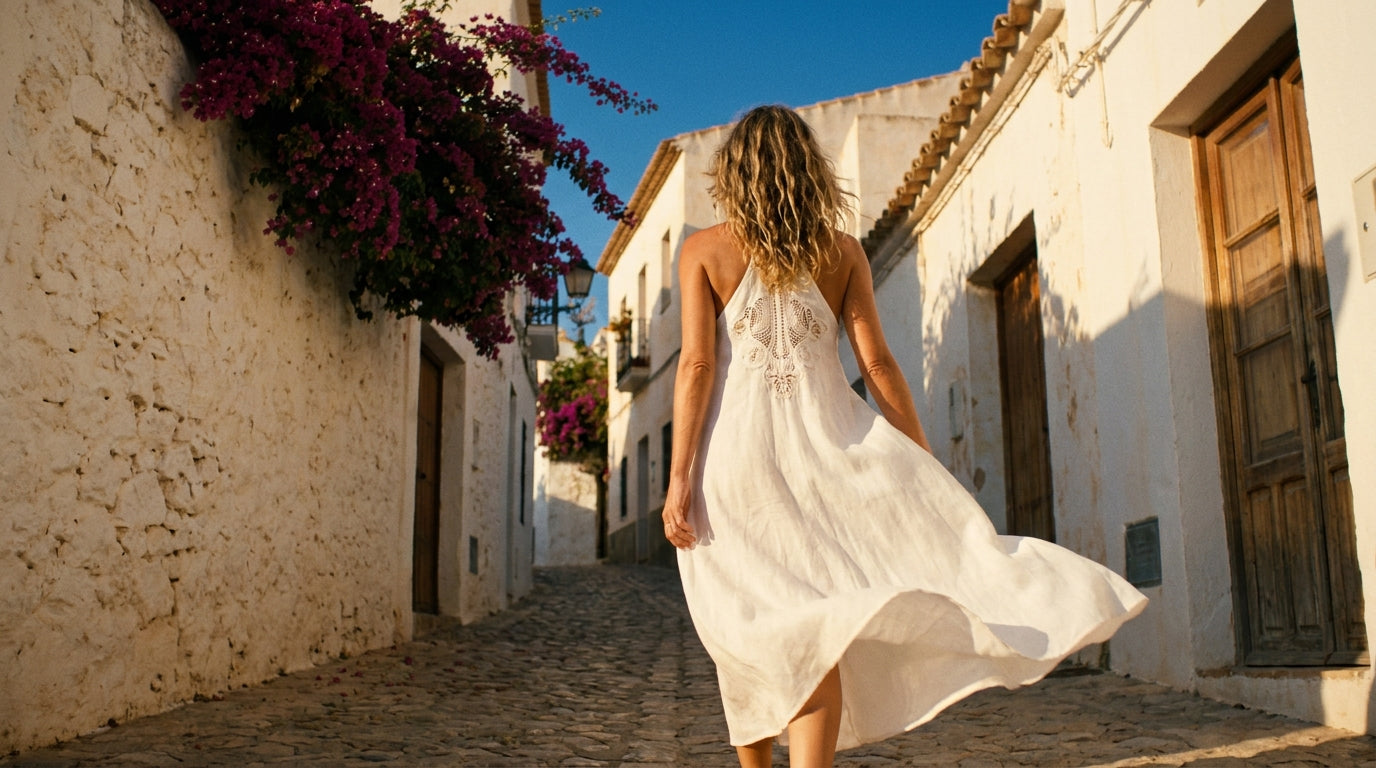
 Woman walking through Dalt Vila at sunset in a white linen dress, embodying authentic Ibizan style
The mental rule that summarizes everything
After all that has been said, if I had to leave you with one mental rule, it would be this: the well-dressed Ibizan style is one that seems to have always been there, not one that draws attention.
A woman in a white linen dress, flat sandals, and a wicker bag, with minimal makeup, loose hair, walking through Dalt Vila at eight in the evening, with apparent effortlessness. That is the code. The feeling that the person and the place have met, not that the person has arrived from elsewhere trying to "fit in."
When you achieve it, people notice. They don't tell you, but they notice. In how the Ibizan women themselves look at you at a wedding, in how they treat you in a local shop, in how you look in photos without needing filters. It's a quiet elegance, without stridency. The one Smilja Mihailovitch had in mind when she decided that her fashion motto would be "ad libitum": as you wish, but with discernment.
And today, anyone who knows that dressing well is not dressing much, has plenty of discernment.
At Martina Ibiza, we have been working with this philosophy for years: pieces in linen, crochet, and organic cotton, handmade in family workshops, within the authentic adlib code. If you want to explore the basic wardrobe I describe above, it's all in our collection of Ibizan dresses. And if you're looking for statement pieces with full embroidery, the pieces from the Atelier collection are the most complete we have made.
Frequently asked questions about Ibizan style
What exactly is adlib fashion?
Adlib fashion is a dress code born in Ibiza in 1971, promoted by Smilja Mihailovitch, which reinterprets traditional peasant attire in a modern key. Its central elements are white as the base color, natural fabrics (linen, crochet, cotton), visible craftsmanship (embroidery, lace), fluid drape, and effortless natural elegance. The name comes from the Latin "ad libitum," meaning "at will," reflecting the freedom of combination within the code.
What is the difference between Ibizan style and boho?
Ibizan style is a specific code anchored to Ibiza, with a white and earthy palette, Mediterranean fabrics (linen, crochet) and local craftsmanship. Boho style is a broader aesthetic with hippie roots that incorporates colors, prints, layers, ethnic accessories (turbans, heavy jewelry, Moroccan or Indian motifs). Both can coexist but confusing them leads to a "costume" effect.
Can I wear black to a wedding in Ibiza?
Yes, but with nuances. Black is outside the pure adlib code, but a black linen dress with a clean cut and fluid drape can work for an evening wedding or from sunset onwards. For morning or midday weddings, white and earthy tones are always the most coherent option with the Ibizan context.
Is it offensive to wear peasant attire if you're not from Ibiza?
Traditional peasant attire (gonella, blouse with filigreed jewelry) is a cultural regional costume. It's not exactly offensive to wear it if you're not Ibizan, but it looks out of place and is interpreted as a costume. The equivalent would be wearing a flamenco dress in Seville without being Sevillian. It's better to opt for adlib or contemporary Ibizan fashion, which are precisely designed to be worn by anyone.
What fabrics should I avoid when dressing in Ibizan style?
Avoid synthetics (polyester, nylon, acrylic), high-polyester blends, shiny satins, stiff fabrics that don't move with the air (like thick twill), and linen imitations. Ibizan style is based on fabrics that breathe and move with the body: linen, organic cotton, crochet, natural viscose, and fine silk are the right choices.
Do I need to wear all white to dress in Ibizan style?
No. White is the predominant color, especially for weddings and white parties, but the code allows for off-white, bone, beige, sand, very diluted terracotta, diluted sage, and natural earthy tones. Touches of color are accepted in embroidery or accessories. What doesn't work are saturated colors (fuchsia, emerald, cobalt) as the main focus of the look.
Does Ibizan style work if I'm over 50?
It works perfectly at any age. In fact, the adlib code was originally invented among women over 40 (Smilja Mihailovitch was 50 when she launched it). The generous cuts, fluid fabrics, and natural elegance are particularly flattering for mature women. It's only necessary to adjust lengths (midi or ankle instead of mini) and simplify accessories.
About the author
Martina is the founder of Martina Ibiza, a contemporary adlib fashion brand based in Spain. She has been working for years with family workshops in Ibiza and on the mainland to create handmade dresses in linen, crochet, and hand embroidery within the authentic adlib code. Here she shares what she learns from her craft.